📌 TOPINDIATOURS Hot ai: China’s BYD launches ride-hailing focused EV brand with up
Recent regulatory filings indicate that BYD is preparing a significant brand restructuring with the launch of its new sub-brand, Linghui, aimed at clearly separating a new group of vehicles from its core product portfolio. As part of this effort, four models – the Linghui e5, Linghui e7, Linghui e9, and Linghui M9 – have already been submitted for approval, signaling that the rollout is moving quickly from planning to execution.
Although positioned as a distinct brand, Linghui appears to be built on BYD’s proven engineering foundations. Early documentation suggests that several of the new models are derived from existing BYD vehicle platforms, but presented under a fresh visual and market identity.
This approach allows BYD to expand its lineup efficiently while reshaping how different segments of its business are perceived by consumers and investors alike.
Linghui lineup highlights battery-first strategy across new models
Rather than being positioned simply as new nameplates, BYD’s first Linghui models are designed to showcase the company’s latest battery and electrification strategy across multiple segments. All four vehicles rely on BYD’s in-house Blade Battery architecture, emphasizing energy density, thermal stability, and long-term durability – which are the key differentiators as competition intensifies in China’s EV market.
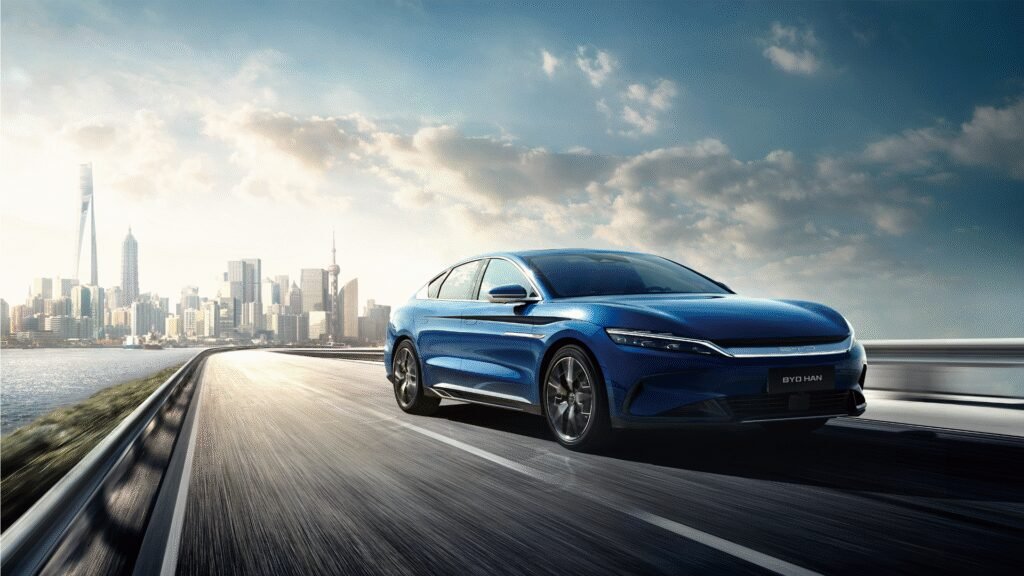
The flagship Linghui e9, derived from the BYD Han, will be offered with two electric motor options delivering up to 150 kW, aligning it with the brand’s premium electric sedan positioning. The Linghui e7 continues the approach with multiple motor configurations aimed at balancing efficiency and performance, CarNewsChina reported.
The more affordable Linghui e5, based on the Qin Plus EV platform, adopts a single-motor setup focused on cost-efficient electrification for high-volume buyers. At the top of the range, the Linghui M9 stands apart with a plug-in hybrid system that combines BYD’s proven 1.5-liter engine with a 200 kW electric motor, highlighting the brand’s dual-track electrification roadmap.
A defining trait of all of these models is their heavy use in ride-hailing fleets. Along with vehicles like the BYD Qin Plus, they have become popular among mobility platforms due to their strong value proposition and low operating costs.
Ride-hailing dominance is eroding consumer brand perception
Market dynamics show that ride-hailing operators prioritize vehicles that deliver the strongest cost-to-performance ratio, often selecting models purely on economic efficiency. While this approach ensures rapid fleet expansion, it creates a branding challenge for automakers whose vehicles become overly associated with ride-hailing services.
Once a brand is perceived primarily as a fleet or ride-hailing choice, consumer perception shifts, CarNewsChina notes. Private buyers increasingly view the brand as low-cost or utilitarian, making it difficult to sustain any premium positioning – and this effect has already reshaped parts of China’s EV market.
Against this backdrop, the launch of the Linghui brand reflects BYD’s effort to isolate its fleet and ride-hailing exposure from its main consumer business. With large numbers of BYD vehicles already operating in ride-hailing fleets across China, creating a dedicated ride-hailing-focused brand allows the Chinese automaker to protect its core brand positioning while responding to mounting competition and slowing domestic sales.
🔗 Sumber: interestingengineering.com
📌 TOPINDIATOURS Breaking ai: New self-healing artificial ‘pain nerves’ could give
Researchers from China’s Northeast Normal University have developed a novel soft, jelly-like electronic “pain nerve” that could give robots human-like reflexes. These “nerves,” the researchers explain, can feel pressure at different intensities, not just on and off.
What’s more, the nerves appear to become more sensitive once they’ve been “injured.” Over time, as they “heal,” the nerves also calm and become less sensitive.
Impressively, the new electronic nerves can physically repair themselves once damaged. They could also, in theory, be used to trigger a reflex, like moving a limb away from a “pain” source.
In this sense, these nerves behave in a very similar manner to biological pain responses. More so, in fact, than previously developed similar robot sensors.
At present, most robot sensors tend to be binary in nature, that is, they can either touch or not. They also tend to be stateless, meaning they “forget” pain immediately after detection.
Rise of the feeling robots
Such sensors also tend to be fragile, meaning any damage tends to mean they need complete replacement. In human beings, your nerves can “encode” how bad pain is.
They also tend to stay extra sensitive after sustaining an injury for a time. Over time, human nerves are then able to return to normal, albeit slowly.
All of this means that your body is able ot provide some protection to damaged tissues in your body. The new robot “nerves,” therefore, attempts to replicate this behavior using hardware, not software.
Key to the new development is something called memristors. These are electronic components whose resistance depends on what has happened to them in the past.
That’s important because neurons remember past stimulation, and pain sensitivity depends on history. However, most memristors flip between two states (i.e., on or off).
The new ones used by the researchers, however, have 16 stable levels, a bit like a dimmer switch instead of a light switch. Each level represents a different pain intensity from no pain at all to mild, moderate, severe, etc.
Further to that, the team also made good use of gelatin (the same protein in collagen). This is an excellent choice as it can conduct ions just like living creatures.
It also naturally self-heals when warmed, and has chemical groups that guide ion movement cleanly. This, the team explains, enables things like magnesium ions to move and form tiny conductive paths.
Tested on mice
These paths form in predictable steps, giving the 16 pain levels for the memristor. This setup enables the pressure sensor to convert physical force into an electronic current that can, in turn, trigger a response, such as muscle activation.
The team was even able to connect the new nerve to a mouse’s sciatic nerve for testing. They found that the sensor was able to trigger a muscle reaction in the mouse just like a natural reflex arc (i.e., no brain required).
What differs from living creatures is how the gelatin can heal. To “heal” the gelatin needs to be exposed to 60 °C to let it re-bond. This is not safe for living things, but is perfectly fine for robots.
This discovery is not about giving robots the ability to feel pain, per se, but is more about engineering safety and durability in robots. It could be used, for example, to help robots protect themselves when in operation.
Perhaps it could even be used to help robots “learn” what is dangerous to touch or not, just like humans learn in childhood. It could, in theory, also be integrated into prosthetics that can respond proportionally to patients.
You can view the study for yourself in the journal Advanced Functional Materials.
🔗 Sumber: interestingengineering.com
🤖 Catatan TOPINDIATOURS
Artikel ini adalah rangkuman otomatis dari beberapa sumber terpercaya. Kami pilih topik yang sedang tren agar kamu selalu update tanpa ketinggalan.
✅ Update berikutnya dalam 30 menit — tema random menanti!