📌 TOPINDIATOURS Hot ai: 7 sunken cities where recent archaeology is rewriting anci
Long before satellites and sonar, entire cities vanished beneath water—some swallowed by earthquakes, others slowly erased by the sea. For centuries, their remains lay hidden, half-remembered in texts, legends, or local lore.
In recent years, however, underwater archaeology has entered a new phase. Between 2024 and early 2026, researchers using advanced diving techniques, geophysical surveys, and 3D reconstruction have revisited some of the world’s most intriguing submerged cities, revealing new details about how they functioned, why they were lost, and what still survives below the waves. These seven sites offer a rare window into urban worlds reshaped by environmental change, natural disasters, and the passage of time.
1) Thonis-Heracleion – Egypt
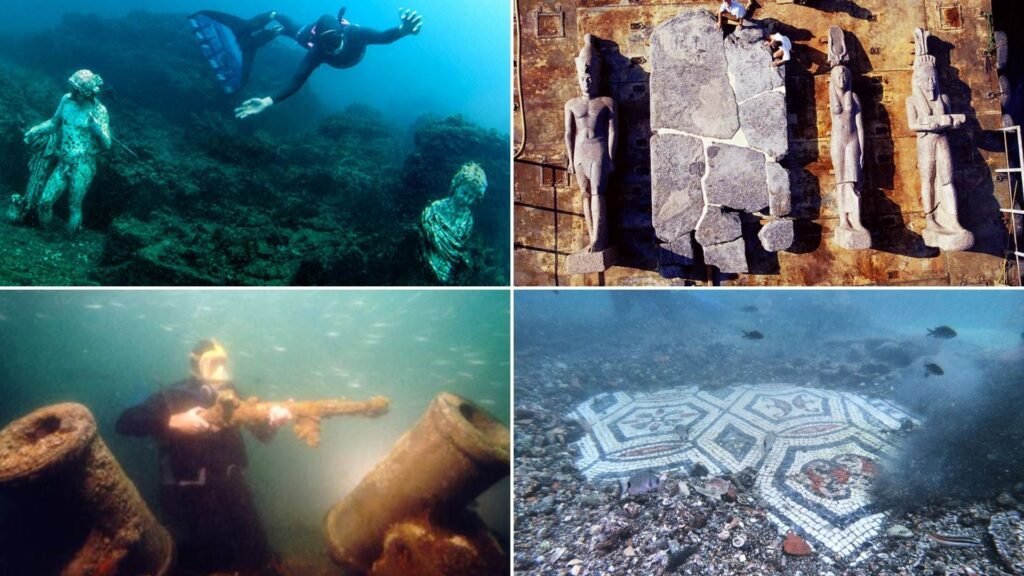
Submerged in Abu Qir Bay near Alexandria, Thonis-Heracleion was a major Egyptian port city linking Mediterranean trade with the Nile’s inland economy. Recent phases of underwater missions led by Franck Goddio’s team (IEASM) documented new zones around the Amun temple complex and identified a Greek sanctuary dedicated to Aphrodite east of it.
Finds reported from these missions include imported bronze and ceramic objects and Greek weapons, supporting the idea that Greek merchants and mercenaries operated within the city well before the Hellenistic era.
The discoveries support Thonis-Heracleion’s role as a multicultural commercial gateway, with religious spaces and trade infrastructure intertwined within a port environment that later became overwhelmed by subsidence and seismic-related flooding.
2) Canopus – Egypt
Canopus, another major city in Abu Qir Bay, continues to yield large Roman-period remains as Egypt lifts and documents seabed structures. Reporting in August 2025 describes surveys revealing what archaeologists characterize as a “complete Roman-era city” footprint underwater, temples, cisterns, quays, and fish tanks, along with recovered statuary and architectural elements.
The picture emerging from these finds is a coastal urban center with substantial waterfront engineering and water-management infrastructure, indicating long-term occupation and rebuilding into the Roman period.
The recovery work also highlights the scale of Canopus’ maritime and commercial functions within the Alexandria region’s economic zone, offering a rare look at urban life and industry now preserved beneath sediment and shallow water.
3) Toru-Aygyr – Lake Issyk-Kul, Kyrgyzstan
In late 2025, underwater archaeologists working in Lake Issyk-Kul reported a major breakthrough at the Toru-Aygyr complex, strengthening the case for a true medieval city rather than a minor outpost. Coverage includes fired-brick buildings, a grain mill/millstone, large ceramic vessels, and, most notably, a substantial 13th–14th-century Muslim necropolis with burials aligned toward Mecca.
Researchers also reported a large building that may have served as a public religious or civic structure (often described as a candidate for a mosque/madrasa/bathhouse). Multiple outlets link the city’s disappearance to a major 15th-century earthquake and subsequent shoreline changes, making Toru-Aygyr one of the clearest “recently surfaced” drowned urban centers tied to Silk Road trade
4) Baiae – Italy
Baiae, the famously luxurious Roman resort on the Bay of Naples, remains one of the world’s most accessible submerged urban sites, and it also produced fresh, well-documented discoveries in 2024–2025. In July 2024, researchers reported an ornate underwater mosaic/opus sectile floor linked to a Roman villa within the submerged archaeological park, highlighting the town’s elite architecture and expensive decorative techniques.
In August 2025, archaeologists announced the discovery of a submerged Roman bathhouse (with features consistent with Roman heating/bathing infrastructure), and some reports suggested it may relate to a high-status villa tradition associated with Rome’s political class. Together, these finds show Baiae isn’t just a known site—it’s still yielding new, headline-grade urban discoveries.
5) Olous – Greece
Olous was an ancient Greek coastal city in northeastern Crete that was gradually submerged by tectonic subsidence and long-term sea-level rise. Unlike cities lost suddenly to earthquakes or tsunamis, parts of Olous have been visible underwater for decades, with walls, building foundations, and other remains lying just offshore near modern Elounda. Classical references confirm its existence, but the city’s full layout and extent were never clearly understood, contributing to its long-standing archaeological mystery.
Rather than representing a new discovery, recent underwater surveys and documentation efforts, including work continuing into the 2020s, have refined earlier observations, using modern recording and geophysical techniques to better map submerged structures.
These studies have confirmed that substantial portions of Olous’ residential and harbor-facing areas now lie beneath shallow coastal waters. Olous is a rare example of a city slowly claimed by the sea, illustrating how gradual environmental change can erase urban centers over centuries while leaving their remains quietly visible below the surface.
6) Dwarka – India
The ancient city of Dwarka, off the coast of Gujarat in western India, has long been identified in archaeology and legend as a major Late Harappan or early historic port town. In early 2026, the Archaeological Survey of India (ASI) announced a renewed program of deeper land and underwater exploration at the site, including the use of modern technologies to probe previously unexamined offshore sectors.
Officials say the upcoming investigations will focus not only on classical coastal remains but also on mapped underwater zones near Bet Dwarka and the Gomti Creek, where structural anomalies and stone features have been observed.
This initiative marks a significant intensification of efforts to document the sunken portions of Dwarka’s urban footprint, suggesting that much larger segments of the ancient built environment lie preserved beneath sediment and shallow water. The work could expand understanding of one of South Asia’s most celebrated submerged cities and its connections to ancient maritime networks.
<h2 class="wp-block-heading" id="h-7-hibara-juku-…
Konten dipersingkat otomatis.
🔗 Sumber: interestingengineering.com
📌 TOPINDIATOURS Update ai: Duffer Brothers Accused of Using ChatGPT for Final Seas
Rumors are running rampant online that Matt and Ross Duffer used OpenAI’s ChatGPT when producing the last season of “Stranger Things” after fans zoomed on a still from a behind-the-scenes documentary that appears to show that one of the brothers had the AI chatbot open while working on the script.
“WTF man, now we know why season 5 sucked,” wrote one upset fan of the show on X-formerly-Twitter in response.
Martina Radwan, director of the documentary “One Last Adventure: The Making of Stranger Things 5,” told The Hollywood Reporter in a new interview that she didn’t witness anybody using ChatGPT in the tv show writer’s room.
“No, of course not,” she said. “I witnessed creative exchanges. I witnessed conversation.”
Of course, a person making a hagiographic documentary about the production of the show for Netflix probably isn’t the world’s most neutral source. And she doesn’t quite shut the door on its use, either.
“But to me it’s like, doesn’t everybody have it open, to just do quick research?” she caveated in her hard-to-follow answer to the question.
Nonetheless, the online controversy and the interview show that many people who watch original entertainment don’t want a whiff of AI around their favorite movies or shows, though some production companies have already made forays into its use, most prominently in “de-aging” actors.
Controversies have erupted online when AI use has been unearthed, including its use in tweaking actor Adrien Brody’s Hungarian accent in the movie “The Brutalist” and for generating promotional posters for director Alex Garland’s movie “Civil War.”
Viewers and industry experts should expect more of these flashpoints to erupt as Hollywood bigwigs debate whether to use AI.
Some are stridently against the tech — director Guillermo del Toro said he would rather die than use it — but entertainment giants are rapidly jumping on board. Disney, for instance, recently signed a $1 billion licensing deal with OpenAI, which will allow users to play with Disney-owned characters in OpenAI’s video generator Sora.
The debate is far from over, though. Big tech has already eaten journalism’s lunch — and perhaps Hollywood is next on the menu.
More on entertainment: OpenAI Says It’s Making a Full Hollywood Movie Using AI
The post Duffer Brothers Accused of Using ChatGPT for Final Season of “Stranger Things” appeared first on Futurism.
🔗 Sumber: futurism.com
🤖 Catatan TOPINDIATOURS
Artikel ini adalah rangkuman otomatis dari beberapa sumber terpercaya. Kami pilih topik yang sedang tren agar kamu selalu update tanpa ketinggalan.
✅ Update berikutnya dalam 30 menit — tema random menanti!