
📌 TOPINDIATOURS Breaking ai: Robots head to building sites as German university te
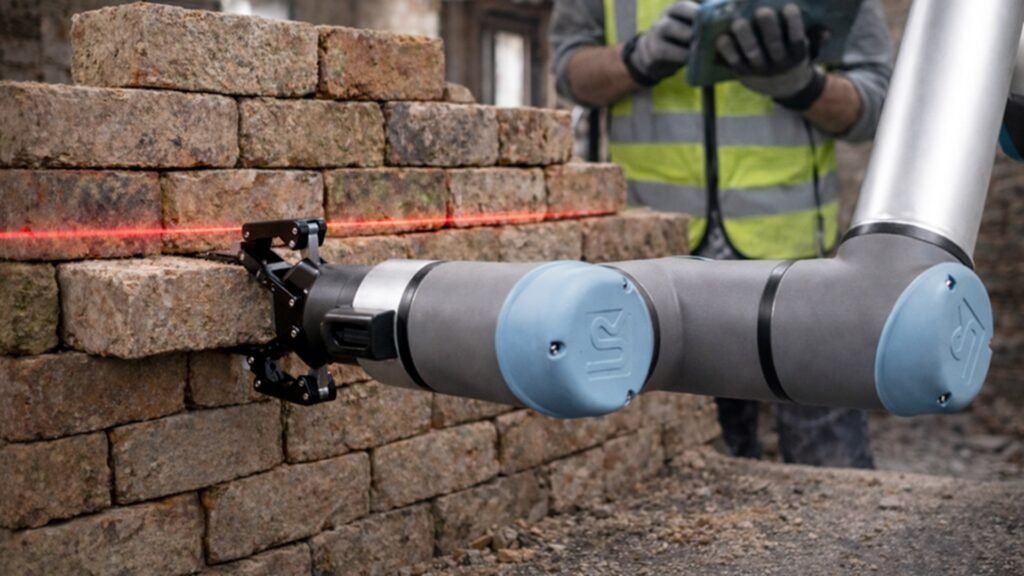
Smart robots and digital tools could soon become a common sight on building sites in Germany after scientists started a research project aimed at introducing them into everyday construction work.
The project was launched by an interdisciplinary team at the state of Thuringia’s Bauhaus-Universität Weimar. Titled “Craft of the Future,” the project will run from 2026 to 2028. It is backed by around USD 1.2 million (EUR 1 million) in funding from the European Social Fund.
Instead of replacing construction workers, the smart robots will work alongside them. They are set to take on some of the most time-consuming and physically demanding tasks on site.
The machines will also be used to scan and assess older buildings, digitally map walls and structural elements, in addition to precisely marking where openings, cuts or modifications are required before construction work begins.
Building the future
Small and medium-sized businesses are under growing strain across Germany. Meanwhile, renovation and refurbishment of existing buildings are becoming more demanding, while skilled workers are increasingly hard to find.
On the other hand, even though digital tools and robots promise support, many novel technologies fail in practice because they are too abstract, too complex or designed without the realities of building sites in mind.
To address the challenge, rather than developing fully autonomous construction robots, the researchers focused on a concept called “assistive digitalization.” Their goal is to support construction workers with tools that fit seamlessly into existing workflows and make everyday tasks easier, safer and more efficient.
“Construction does not work without people and purely autonomous or machine-driven building processes often fail in practice,” the scientists said. “The aim of the research project is therefore to put tradespeople at the center, developing digital innovations from the perspective of those carrying out the work and in close cooperation with planning offices and craft businesses.”
Construction goes digital
To examine the full construction process, from surveying existing buildings and digital planning to on-site execution, architects, civil engineers, designers and computer scientists at the university are working closely with industry partners.
Their work mostly targets renovation and refurbishment, which are areas where unexpected site conditions, existing structures, as well as tight spaces often make automation particularly challenging.
By 2028, the team aims to deliver a range of practical solutions that small and medium-sized firms can realistically adopt. These include digital surveying tools, networked planning systems and collaborative industrial robots that can work safely alongside humans.
Possible applications include assessing building conditions, digitally marking wall openings and assisting with material removal, and other physically demanding tasks. The systems will be tested, refined and demonstrated in real-world settings to ensure they are robust enough for everyday use.
According to the team one of the biggest barriers to digitalization in construction is the lack of standards, interfaces and hands-on experience within many firms. The project will directly address this by analyzing every step of the work process and developing user-friendly interfaces that lower the barrier to entry.
“Digital methods and robotic systems can reduce physically demanding tasks, improve occupational health and safety and enable small teams to handle larger project volumes,” the university said in a press release. “In addition, precise, data-driven planning and construction processes can help avoid errors and rework while making more efficient use of materials.”
🔗 Sumber: interestingengineering.com
📌 TOPINDIATOURS Update ai: New Law Would Let Grok Victims Sue Creeps Who Generated
On Tuesday, the US senate passed a new law that would allow victims to sue individuals who use AI models like Grok to generate non-consensual nudes and other sexually explicit images.
Dubbed the Disrupt Explicit Forged Images and Non-Consensual Edits (DEFIANCE) Act, it expands on another law passed last year, the Take It Down Act, which made it illegal to distribute nonconsensual intimate images and required social media companies to remove them within 48 hours, by empowering victims to go after the people responsible for generating the images, including seeking damages and imposing restraining orders, Bloomberg noted.
The new law was put forth by Senator Dick Durbin (D-Ill) and passed unanimously.
“Give to the victims their day in court to hold those responsible who continue to publish these images at their expense,” Durbin said in a speech on the Senate floor, via The Hill. “Today, we are one step closer to making this a reality.”
The bill comes as Elon Musk’s X is facing vociferous public backlash after his AI chatbot Grok was used to generate thousands of nudes and sexually explicit images of both adults and children whose photos had been posted to the platform. The volume of these images was so overwhelming that the AI content analysis firm Copyleaks estimated the bot was generating a nonconsensually sexualized image every single minute.
The lack of response from xAI, the Musk-owned AI startup that develops Grok, has only further catalyzed the outrage from the public and regulators alike, to say nothing of Musk’s blasé attitude to it all. He only indirectly addressed the pornographic generations without ever explicitly mentioning them by asserting in a post that “anyone using Grok to make illegal content will suffer the same consequences as if they upload illegal content.” He also joked that the nonconsensual undressing “trend” was “way funnier” than the trends started by other AI chatbots.
If Musk has failed to comprehend the gravity of the situation, governments have not. Some countries, including Malaysia and Indonesia, have moved to ban access to his website entirely. UK prime minister Keir Starmer warned that he would bring the hammer down on X while the country’s communications regulator, Ofcom, launched an official investigation into the company.
“Imagine losing control of your own likeness or identity,” said Durbin, per The Hill. “Imagine that happening to you when you were in high school. Imagine how powerless victims feel when they cannot remove illicit content, cannot prevent it from being reproduced repeatedly and cannot prevent new images from being created.”
“The consequences can be profound,” he added.
The DEFIANCE Act now needs to pass a vote in the House before it can officially become law. It had already passed a vote in the Senate when it was previously proposed in 2024, but didn’t pass the lower chamber. Now, with the outrage over Grok, it may stand a better chance.
More on AI: Opposition to Elon Musk’s AI Stripping Clothing Off Children Is Nearly Universal, Polling Shows
The post New Law Would Let Grok Victims Sue Creeps Who Generated Nonconsensual Nudes appeared first on Futurism.
🔗 Sumber: futurism.com
🤖 Catatan TOPINDIATOURS
Artikel ini adalah rangkuman otomatis dari beberapa sumber terpercaya. Kami pilih topik yang sedang tren agar kamu selalu update tanpa ketinggalan.
✅ Update berikutnya dalam 30 menit — tema random menanti!
