📌 TOPINDIATOURS Eksklusif ai: AI robot dogs take over dangerous firefighting missi
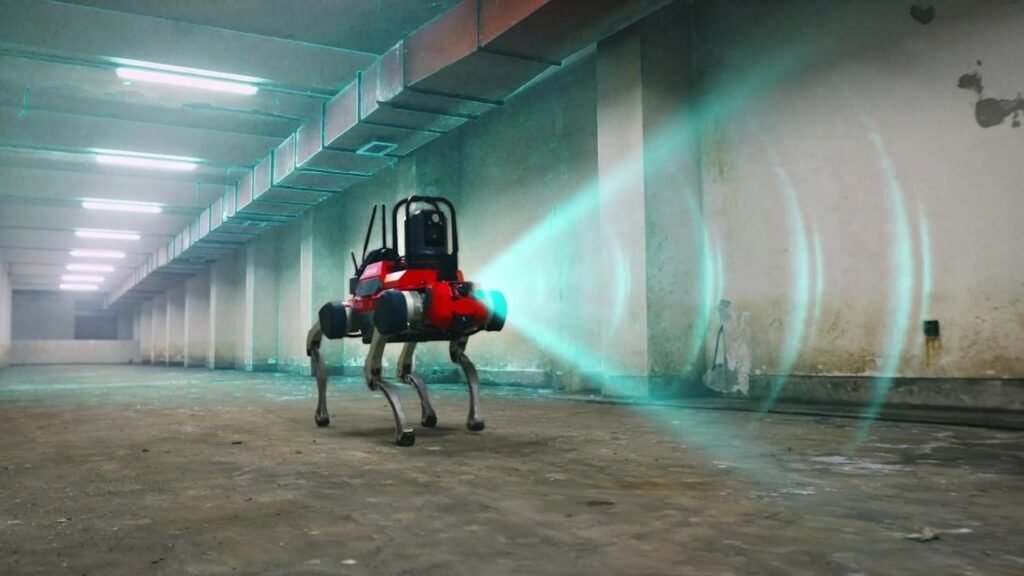
Robotics firm DEEP Robotics has introduced its “Emergency Firefighting Solution,” a system that integrates AI to disrupt the traditional firefighting technology sector.
The new platform was designed to shift the focus away from human-led efforts toward intelligent, collaborative systems. Essentially, it uses a team of robot dogs to carry out different functions, allowing for extremely efficient disaster response. In doing so, it allows operators to minimize risks to human first responders.
A closed-loop firefighting system
The Emergency Firefighting Solution comprises a suite of specialized robots, including wheeled-legged and quadruped reconnaissance units, firefighting robots equipped with water guns and cannons, and logistics bots.
According to a press statement, DEEP Robotics’ new system is “far more than a single robot product.”
Instead, it is a “full-link closed-loop system encompassing forward reconnaissance, precise response, intelligent transport, and reliable communication.”
The robots are designed to tackle extreme scenarios like fires, chemical leaks, and natural disasters. The reconnaissance robots utilize high-precision LiDAR, dual-spectrum PTZ cameras, and gas-sensing modules to navigate rubble, detect harmful gases, and locate trapped individuals in smoke-filled or low-light areas. They can even use voice modules to provide reassurance to those in distress.
The system’s fire suppression capabilities are equally impressive. Quadruped water gun robots deploy high-pressure pulse systems to release micron-level water mist.
This quickly controls flames while maintaining “man-fire separation” to protect human operators.
Water cannon robots, meanwhile, project water or foam up to 60 meters with adjustable spray patterns, ensuring precise targeting even in obstructed environments.
Both types feature dual-layer spray cooling to withstand high temperatures, making them reliable in prolonged operations. Finally, DEEP’s logistics robots add another layer of support by autonomously transporting essential supplies like air cylinders and breaching tools.
Successful real-world tests
The entire system is bolstered by multi-link communication technology, offering millisecond-level low latency and functionality in weak-signal zones.
Integration with drones creates an “air-ground-underground” network for comprehensive situational awareness, including real-time data transmission and 3D point cloud mapping.
According to DEEP, its system has already shown its worth in real-world settings.
At Fuzhou City’s Emergency Firefighting Robot and Drone Competition, the company’s X30 robot dog won a blind-zone tunnel scenario competition with over 65% obstacle coverage.
Similarly, during the 2025 Joint Emergency Rescue Drill, the firm’s robots successfully navigated scaffold collapses, hazardous leaks, and fires, locating all trapped personnel.
In an Inner Mongolia natural gas leak incident, meanwhile, they provided initial environmental detection, significantly boosting response efficiency.
The company also says its quadruped robot holds a “90 percent market share in the firefighting industry”, meaning it has become “the industry benchmark”.
🔗 Sumber: interestingengineering.com
📌 TOPINDIATOURS Eksklusif ai: Cambridge team unveils AI wearable collar to help st
Scientists in the UK have just unveiled a new wearable AI-powered choker device that could help people recover speech after a stroke without the need for invasive brain implants.
The comfortable and washable device, called Revoice, was developed by a research team at the University of Cambridge. It uses a mix of ultra-sensitive sensors and AI to decode speech signals and emotional cues.
Made for patients with dysarthria, a post-stroke condition caused by weakened muscles in the face, mouth and throat, the device utilizes two AI components that process the signals together.
While one of them reconstructs fragments of silently mouthed words from throat vibrations, the other interprets emotional and contextual signals, such as the time of day or weather conditions, to expand short phrases into complete sentences.
Wearable voice recovery
Instead of relying on surgically implanted brain electrodes or slow, letter-by-letter communication interfaces, Revoice captures the wearer’s heart rate along with tiny vibrations from throat muscles.
It then uses the signals to reconstruct intended words and sentences in real time. According to the researchers, the system enables speech that sounds natural and fluid, rather than robotic or overly simplified.
Led by Luigi Occhipinti, PhD, a professor at the Department of Engineering, the study involved five stroke patients with dysarthria. The device achieved a word error rate of just 4.2 percent and a sentence error rate of 2.9 percent. In addition, the participants noted a 55 percent rise in user satisfaction.
Credit: University of Cambridge
“When people have dysarthria following a stroke, it can be extremely frustrating for them, because they know exactly what they want to say, but physically struggle to say it, because the signals between their brain and their throat have been scrambled by the stroke,” Occhipinti stated.
Occhipinti said the frustration can be profound, affecting not only patients but also their caregivers and families. Typical dysarthria recovery time varies from a few months to a year or more.
Helping patients speak
As per the scientists, Revoice also stands out for its practicality. The technology is lightweight, washable and designed for everyday use. It runs on an embedded, energy-efficient language model, meaning it requires minimal power.
“And as many patients do recover most or all of their speech eventually, there is not a need for invasive brain implants, but there is a strong need for speech solutions that are more intuitive and portable,” Occhipinti revealed.
Apart from stroke rehabilitation, the technology could eventually support people with other neurological conditions, including Parkinson’s disease or motor neuron disease, where speech degradation is progressive.
“This is about giving people their independence back,” Occhipinti concluded in a press release. “Communication is fundamental to dignity and recovery.”
The research was supported in part by the British Council, Haleon, as well as the Engineering and Physical Sciences Research Council (EPSRC), part of UK Research and Innovation (UKRI).
The study has been published in the journal Nature Communications.
🔗 Sumber: interestingengineering.com
🤖 Catatan TOPINDIATOURS
Artikel ini adalah rangkuman otomatis dari beberapa sumber terpercaya. Kami pilih topik yang sedang tren agar kamu selalu update tanpa ketinggalan.
✅ Update berikutnya dalam 30 menit — tema random menanti!