📌 TOPINDIATOURS Update ai: Earthquake detectors can track sonic booms to pinpoint
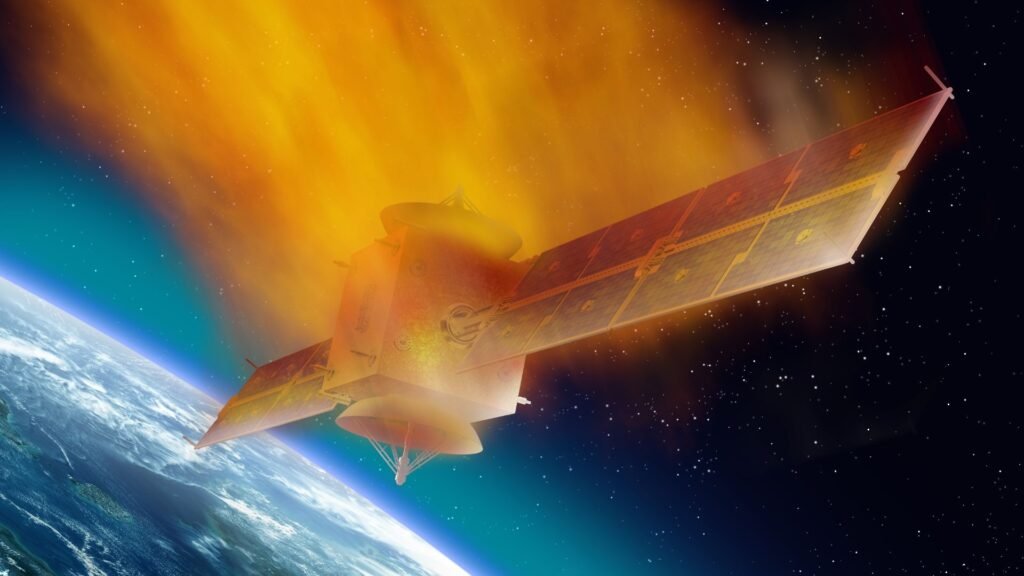
Space debris is becoming an overwhelming problem. With operators increasingly sending satellites and other payloads to Earth’s orbit, the risk of collisions continues to increase at an alarming rate.
Between 2019 and 2023, for example, SpaceX’s Starlink satellites made more than 50,000 collision avoidance maneuvers in low Earth orbit. A collision would lead to even more space debris, and more risk of it falling over populated areas on Earth.
Now, in a bid to quickly identify possible debris crash sites, scientists have devised a new method for tracking falling debris. The method would leverage existing seismometer networks to pinpoint loud sonic booms caused by space debris as it falls to Earth. Ultimately, this could allow for quick retrieval of potentially toxic materials.
Tracking sonic booms with earthquake detectors
The new tracking method takes advantage of existing global seismometer networks. These are utilized on Earth to detect earthquakes, meaning they can provide near real-time information on a global scale.
The method tracks loud sonic boom shockwaves created by space debris as it reenters our atmosphere. It was devised by Johns Hopkins postdoctoral research fellow Benjamin Fernando, with help from Constantinos Charalambous, a research fellow at Imperial College London.
In a paper published in the journal Science, Fernando and Charalambous explain how space debris entering Earth’s atmosphere moves several times faster than the speed of sound. This results in a sonic boom, similar to those produced by a fighter jet. As the debris falls, it leaves a trail of shock waves in its wake. These alert seismometers, creating data points for the new detection method.
By mapping out the activated seismometers, the researchers could follow the trajectory of a specific piece of debris. This allowed them to determine its direction and estimate where it landed.
Specifically, Fernando and Charalambous reconstructed the trajectory of debris from China’s Shenzhou-15 spacecraft. The orbital module reentered Earth’s atmosphere on April 2, 2024. It was roughly 3.5 feet wide and weighed more than 1.5 tons. According to the scientists, the size meant it could pose a threat to people on the ground.
Tracking the Shenzhou-15 space debris
The team analyzed data from 127 seismometers in southern California and calculated the Shenzhou-15 space debris’s speed. They found that it was flying somewhere between Mach 25-30—between 25 and 30 times the speed of sound. According to the researchers, it flew over Santa Barbara and Las Vegas at roughly 10 times the speed of the world’s fastest jet.
Their calculations also showed that the module was traveling roughly 25 miles north of the trajectory predicted by US Space Command. According to the researchers, radar data reentry estimations can be off by thousands of miles in the worst cases. Now, their new method could complement radar data, providing much more accurate results.
“Re-entries are happening more frequently,” Fernando, who is the lead author on the Science paper, explained in a press statement. “Last year, we had multiple satellites entering our atmosphere each day, and we don’t have independent verification of where they entered, whether they broke up into pieces, if they burned up in the atmosphere, or if they made it to the ground. This is a growing problem, and it’s going to keep getting worse.”
The growing space debris problem
With debris flying around Earth at speeds of 8 kilometers per second—faster than a bullet—collisions are increasingly likely. In a recent interview with IE, University of Regina astronomer Samantha Lawler said, “I hate to say this, but I really do think it will take a death before government regulators pay attention to the problem of space debris.”
However, the problem goes beyond the impact risk of space debris causing damage to populated areas. Debris can also carry harmful substances, meaning fast retrieval is important.
“In 1996, debris from the Russian Mars 96 spacecraft fell out of orbit. People thought it burned up, and its radioactive power source landed intact in the ocean,” Fernando explained. “People tried to track it at the time, but its location was never confirmed. More recently, a group of scientists found artificial plutonium in a glacier in Chile that they believe is evidence the power source burst open during the descent and contaminated the area.”
“We’d benefit from having additional tracking tools,” he continued, “especially for those rare occasions when debris has radioactive material.”
🔗 Sumber: interestingengineering.com
📌 TOPINDIATOURS Breaking ai: Which Agent Causes Task Failures and When?Researchers
Share My Research is Synced’s column that welcomes scholars to share their own research breakthroughs with over 1.5M global AI enthusiasts. Beyond technological advances, Share My Research also calls for interesting stories behind the research and exciting research ideas. Contact us: chain.zhang@jiqizhixin.com
Meet the authors
Institutions: Penn State University, Duke University, Google DeepMind, University of Washington, Meta, Nanyang Technological University, and Oregon State University. The co-first authors are Shaokun Zhang of Penn State University and Ming Yin of Duke University.
In recent years, LLM Multi-Agent systems have garnered widespread attention for their collaborative approach to solving complex problems. However, it’s a common scenario for these systems to fail at a task despite a flurry of activity. This leaves developers with a critical question: which agent, at what point, was responsible for the failure? Sifting through vast interaction logs to pinpoint the root cause feels like finding a needle in a haystack—a time-consuming and labor-intensive effort.
This is a familiar frustration for developers. In increasingly complex Multi-Agent systems, failures are not only common but also incredibly difficult to diagnose due to the autonomous nature of agent collaboration and long information chains. Without a way to quickly identify the source of a failure, system iteration and optimization grind to a halt.
To address this challenge, researchers from Penn State University and Duke University, in collaboration with institutions including Google DeepMind, have introduced the novel research problem of “Automated Failure Attribution.” They have constructed the first benchmark dataset for this task, Who&When, and have developed and evaluated several automated attribution methods. This work not only highlights the complexity of the task but also paves a new path toward enhancing the reliability of LLM Multi-Agent systems.
The paper has been accepted as a Spotlight presentation at the top-tier machine learning conference, ICML 2025, and the code and dataset are now fully open-source.
Paper:https://arxiv.org/pdf/2505.00212
Code:https://github.com/mingyin1/Agents_Failure_Attribution
Dataset:https://huggingface.co/datasets/Kevin355/Who_and_When
Research Background and Challenges
LLM-driven Multi-Agent systems have demonstrated immense potential across many domains. However, these systems are fragile; errors by a single agent, misunderstandings between agents, or mistakes in information transmission can lead to the failure of the entire task.
Currently, when a system fails, developers are often left with manual and inefficient methods for debugging:
Manual Log Archaeology : Developers must manually review lengthy interaction logs to find the source of the problem.
Reliance on Expertise : The debugging process is highly dependent on the developer’s deep understanding of the system and the task at hand.
This “needle in a haystack” approach to debugging is not only inefficient but also severely hinders rapid system iteration and the improvement of system reliability. There is an urgent need for an automated, systematic method to pinpoint the cause of failures, effectively bridging the gap between “evaluation results” and “system improvement.”
Core Contributions
This paper makes several groundbreaking contributions to address the challenges above:
1. Defining a New Problem: The paper is the first to formalize “automated failure attribution” as a specific research task. This task is defined by identifying the failure-responsible agent and the decisive error step that led to the task’s failure.
2. Constructing the First Benchmark Dataset: Who&When : This dataset includes a wide range of failure logs collected from 127 LLM Multi-Agent systems, which were either algorithmically generated or hand-crafted by experts to ensure realism and diversity. Each failure log is accompanied by fine-grained human annotations for:
Who: The agent responsible for the failure.
When: The specific interaction step where the decisive error occurred.
Why: A natural language explanation of the cause of the failure.
3. Exploring Initial “Automated Attribution” Methods : Using the Who&When dataset, the paper designs and assesses three distinct methods for automated failure attribution:
– All-at-Once: This method provides the LLM with the user query and the complete failure log, asking it to identify the responsible agent and the decisive error step in a single pass. While cost-effective, it may struggle to pinpoint precise errors in long contexts.
– Step-by-Step: This approach mimics manual debugging by having the LLM review the interaction log sequentially, making a judgment at each step until the error is found. It is more precise at locating the error step but incurs higher costs and risks accumulating errors.
– Binary Search: A compromise between the first two methods, this strategy repeatedly divides the log in half, using the LLM to determine which segment contains the error. It then recursively searches the identified segment, offering a balance of cost and performance.
Experimental Results and Key Findings
Experiments were conducted in two settings: one where the LLM knows the ground truth answer to the problem the Multi-Agent system is trying to solve (With Ground Truth) and one where it does not (Without Ground Truth). The primary model used was GPT-4o, though other models were also tested. The systematic evaluation of these methods on the Who&When dataset yielded several important insights:
– A Long Way to Go: Current methods are far from perfect. Even the best-performing single method achieved an accuracy of only about 53.5% in identifying the responsible agent and a mere 14.2% in pinpointing the exact error step. Some methods performed even worse than random guessing, underscoring the difficulty of the task.
– No “All-in-One” Solution: Different methods excel at different aspects of the problem. The All-at-Once method is better at identifying “Who,” while the Step-by-Step method is more effective at determining “When.” The Binary Search method provides a middle-ground performance.
– Hybrid Approaches Show Promise but at a High Cost: The researchers found that combining different methods, such as using the All-at-Once approach to identify a potential agent and then applying the Step-by-Step method to find the error, can improve overall performance. However, this comes with a significant increase in computational cost.
– State-of-the-Art Models Struggle: Surprisingly, even the most advanced reasoning models, like OpenAI o1 and DeepSeek R1, find this task challenging.- This h…
Konten dipersingkat otomatis.
🔗 Sumber: syncedreview.com
🤖 Catatan TOPINDIATOURS
Artikel ini adalah rangkuman otomatis dari beberapa sumber terpercaya. Kami pilih topik yang sedang tren agar kamu selalu update tanpa ketinggalan.
✅ Update berikutnya dalam 30 menit — tema random menanti!