
📌 TOPINDIATOURS Breaking ai: Small nuclear reactors could replace fossil plants af
Terra Innovatum Global N.V., an Italian developer of micro-modular reactors, has confirmed that it has secured its supply chain for both critical and non-critical components for its SOLO reactor unit. This is a major milestone for the company as it prepares to deploy its uniquely sized nuclear reactor starting in 2028.
As the world looks to move away from fossil fuels, non-carbon-emitting alternatives are being sought. Nuclear fusion energy might be a few years away from being commercially viable, but fission energy, which has been around for decades, can also perform this role.
Instead of building large-scale fission reactors, which are often accompanied by time and cost overruns, efforts are underway to switch to small modular reactors (SMR) that can be built at scale at a central facility and deployed easily worldwide.
With the SOLO, Terra Innovatum is going a step further by building micromodular nuclear reactors with extremely small footprints, making them even easier to deploy.
What is SOLO?
Conceptualized in 2018, SOLO has been in development ever since, with over six years of intense engineering efforts to bring it closer to reality. Last year, Interesting Engineering reported that the reactor design had been submitted to the US Nuclear Regulatory Commission (NRC) for a safety review.
The reactor design is unique because it uses off-the-shelf components, which can deliver cost-effectiveness and rapid deployment. Additionally, it offers fuel flexibility by supporting both LEU+ and HALEU, allowing the reactor to transition to newer fuels when they become available.
The nuclear reactor has a maximum capacity of 1 MWe but, given its modular design, can be scaled up to deliver up to 1 GW of power. With a small footprint, these reactors are ideal replacements for fossil-fuel-powered thermal power plants and can be configured to deliver electricity, heat, or both to industrial processes in off-grid or mini-grid settings.
Securing the supply chain
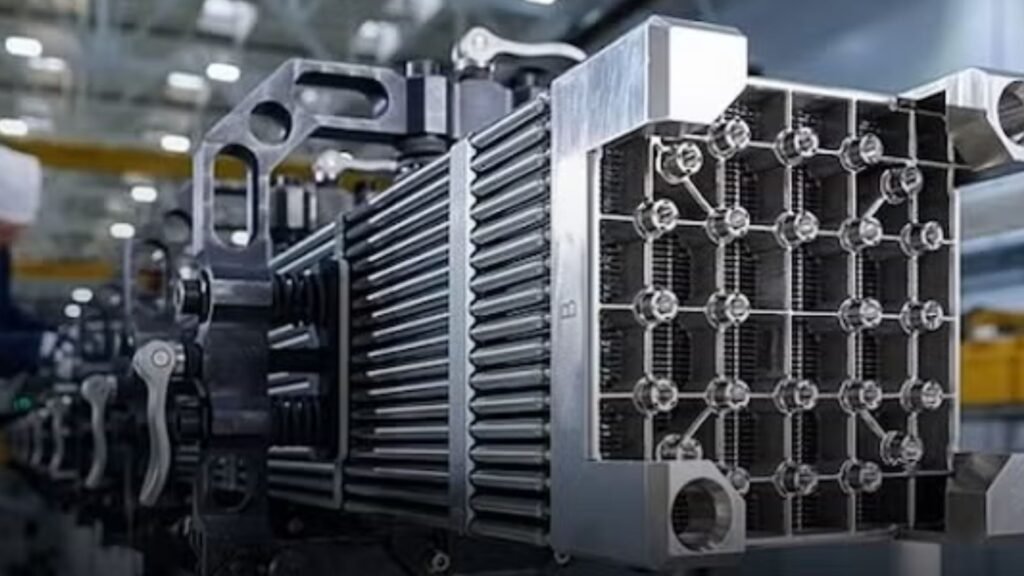
In a recent press release, the company confirmed that it had secured the supply chain for both critical and non-critical components for its SOLO reactor. The critical components include nuclear-grade components such as the pressure vessel, cooling tubes, control and shutdown mechanisms, instrumentation, and controls, as well as the reactor fuel.
These are the highest barriers to entry for nuclear reactor construction. Securing the supply chain for these demonstrates Terra Innovatum’s manufacturing and deployment readiness. The company has also secured the supply chain for non-nuclear grade components.
While the entry barrier for these may not be high, they are mission-critical as well. These include helium circulators, turbines, steam generators, pumps, and instrumentation and controls for the reactor’s power and heat generation.
“Our progress across both the nuclear and non-nuclear supply chain reflects disciplined engineering and a design philosophy centered on execution and on exploiting consolidated R&D and past experience”, said Marco Cherubini, Co-Founder, Chief Technology Officer & Product Director in the press release.
“This momentum strengthens our path toward commercialization and reinforces Terra Innovatum’s role in producing and delivering the next generation of scalable, reliable energy solutions.”
🔗 Sumber: interestingengineering.com
📌 TOPINDIATOURS Update ai: Anthropic launches Cowork, a Claude Desktop agent that
Anthropic released Cowork on Monday, a new AI agent capability that extends the power of its wildly successful Claude Code tool to non-technical users — and according to company insiders, the team built the entire feature in approximately a week and a half, largely using Claude Code itself.
The launch marks a major inflection point in the race to deliver practical AI agents to mainstream users, positioning Anthropic to compete not just with OpenAI and Google in conversational AI, but with Microsoft's Copilot in the burgeoning market for AI-powered productivity tools.
"Cowork lets you complete non-technical tasks much like how developers use Claude Code," the company announced via its official Claude account on X. The feature arrives as a research preview available exclusively to Claude Max subscribers — Anthropic's power-user tier priced between $100 and $200 per month — through the macOS desktop application.
For the past year, the industry narrative has focused on large language models that can write poetry or debug code. With Cowork, Anthropic is betting that the real enterprise value lies in an AI that can open a folder, read a messy pile of receipts, and generate a structured expense report without human hand-holding.
How developers using a coding tool for vacation research inspired Anthropic's latest product
The genesis of Cowork lies in Anthropic's recent success with the developer community. In late 2024, the company released Claude Code, a terminal-based tool that allowed software engineers to automate rote programming tasks. The tool was a hit, but Anthropic noticed a peculiar trend: users were forcing the coding tool to perform non-coding labor.
According to Boris Cherny, an engineer at Anthropic, the company observed users deploying the developer tool for an unexpectedly diverse array of tasks.
"Since we launched Claude Code, we saw people using it for all sorts of non-coding work: doing vacation research, building slide decks, cleaning up your email, cancelling subscriptions, recovering wedding photos from a hard drive, monitoring plant growth, controlling your oven," Cherny wrote on X. "These use cases are diverse and surprising — the reason is that the underlying Claude Agent is the best agent, and Opus 4.5 is the best model."
Recognizing this shadow usage, Anthropic effectively stripped the command-line complexity from their developer tool to create a consumer-friendly interface. In its blog post announcing the feature, Anthropic explained that developers "quickly began using it for almost everything else," which "prompted us to build Cowork: a simpler way for anyone — not just developers — to work with Claude in the very same way."
Inside the folder-based architecture that lets Claude read, edit, and create files on your computer
Unlike a standard chat interface where a user pastes text for analysis, Cowork requires a different level of trust and access. Users designate a specific folder on their local machine that Claude can access. Within that sandbox, the AI agent can read existing files, modify them, or create entirely new ones.
Anthropic offers several illustrative examples: reorganizing a cluttered downloads folder by sorting and intelligently renaming each file, generating a spreadsheet of expenses from a collection of receipt screenshots, or drafting a report from scattered notes across multiple documents.
"In Cowork, you give Claude access to a folder on your computer. Claude can then read, edit, or create files in that folder," the company explained on X. "Try it to create a spreadsheet from a pile of screenshots, or produce a first draft from scattered notes."
The architecture relies on what is known as an "agentic loop." When a user assigns a task, the AI does not merely generate a text response. Instead, it formulates a plan, executes steps in parallel, checks its own work, and asks for clarification if it hits a roadblock. Users can queue multiple tasks and let Claude process them simultaneously — a workflow Anthropic describes as feeling "much less like a back-and-forth and much more like leaving messages for a coworker."
The system is built on Anthropic's Claude Agent SDK, meaning it shares the same underlying architecture as Claude Code. Anthropic notes that Cowork "can take on many of the same tasks that Claude Code can handle, but in a more approachable form for non-coding tasks."
The recursive loop where AI builds AI: Claude Code reportedly wrote much of Claude Cowork
Perhaps the most remarkable detail surrounding Cowork's launch is the speed at which the tool was reportedly built — highlighting a recursive feedback loop where AI tools are being used to build better AI tools.
During a livestream hosted by Dan Shipper, Felix Rieseberg, an Anthropic employee, confirmed that the team built Cowork in approximately a week and a half.
Alex Volkov, who covers AI developments, expressed surprise at the timeline: "Holy shit Anthropic built 'Cowork' in the last… week and a half?!"
This prompted immediate speculation about how much of Cowork was itself built by Claude Code. Simon Smith, EVP of Generative AI at Klick Health, put it bluntly on X: "Claude Code wrote all of Claude Cowork. Can we all agree that we're in at least somewhat of a recursive improvement loop here?"
The implication is profound: Anthropic's AI coding agent may have substantially contributed to building its own non-technical sibling product. If true, this is one of the most visible examples yet of AI systems being used to accelerate their own development and expansion — a strategy that could widen the gap between AI labs that successfully deploy their own agents internally and those that do not.
Connectors, browser automation, and skills extend Cowork's reach beyond the local file system
Cowork doesn't operate in isolation. The feature integrates with Anthropic's existing ecosystem of connectors — tools that link Claude to external information sources and services such as Asana, Notion, PayPal, and other supported partners. Users who have configured these connections in the standard Claude interface can leverage them within Cowork sessions.
Additionally, Cowork can pair with Claude in Chrome, Anthropic's browser…
Konten dipersingkat otomatis.
🔗 Sumber: venturebeat.com
🤖 Catatan TOPINDIATOURS
Artikel ini adalah rangkuman otomatis dari beberapa sumber terpercaya. Kami pilih topik yang sedang tren agar kamu selalu update tanpa ketinggalan.
✅ Update berikutnya dalam 30 menit — tema random menanti!
