📌 TOPINDIATOURS Eksklusif ai: Tiny microfluidic chip extracts forever chemicals fr
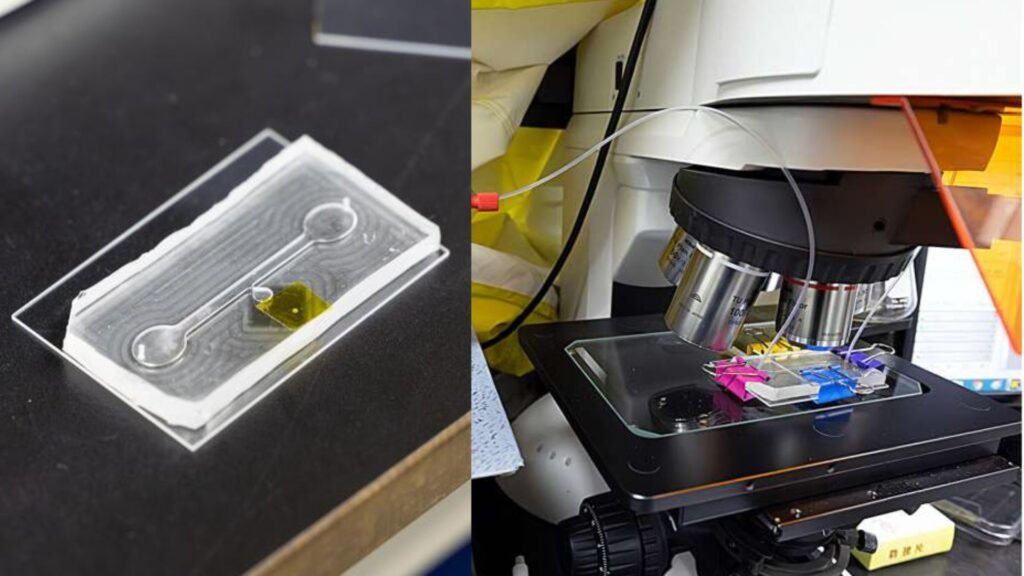
Researchers have engineered a microfluidic device that extracts pollutants directly from contaminated solids. This breakthrough eliminates the need for complex filtration in environmental testing.
The joint team from the Korea Research Institute of Chemical Technology (KRICT) and Chungnam National University published their findings in ACS Sensors.
Led by Dr. Ju Hyeon Kim and Professor Jae Bem You, the group solved a long-standing hurdle in analytical chemistry.
Standard water and food testing often fails when sand, soil, or food residues are present.
These solids decrease accuracy and trap trace pollutants during the filtration process.
Current analytical approaches follow a rigid, multistep workflow including solid removal, extraction, and analysis. This path increases time and costs while reducing reliability.
These limitations pose significant challenges in fields closely related to public health.
This includes environmental monitoring and drinking water safety.
Solving filtration problem
Traditional methods rely on liquid-liquid extraction (LLE) to find hazardous contaminants. These processes require massive amounts of solvents and are difficult to automate.
While liquid-liquid microextraction (LLME) exists, its practical application remained limited.
Samples containing solid particles still require a filtration step prior to extraction.
The new microfluidic-based analytical device uses a trap-based design to bypass these hurdles. It confines a tiny extractant droplet inside a specific microchamber.
Meanwhile, the sample solution flows through an adjacent microchannel.
This allows target analytes to move into the extractant while solid particles pass by. The design enables rapid and selective mass transfer without any interference from the grit.
After extraction, the researcher simply retrieves the droplet for downstream analysis.
Testing real-world samples
The team tested the device on perfluorooctanoic acid (PFOA) and the drug carbamazepine (CBZ). PFOA belongs to the PFAS family of “forever chemicals” currently facing strict U.S. regulations.
The device detected PFOA signals in under five minutes. Researchers also extracted CBZ from sand-containing slurry without any prior filtration.
They identified the compound clearly using high-performance liquid chromatography (HPLC).
The results show the platform maintains high reliability while slashing the number of necessary steps.
This makes it a prime candidate for compact, automated monitoring systems.
It offers a scalable solution for food safety inspection and pharmaceutical residue analysis.
The system handles complex mixtures that would typically clog standard laboratory equipment.
Dr. Kim believes the integration of these steps will revolutionize on-site analysis.
“Integrating multiple pretreatment steps into a single process offers substantial advantages for on-site analysis and automated systems,” he noted.
The technology holds massive potential for drinking water safety.
KRICT President Young-Kuk Lee also praised the development for its societal benefits.
“This technology can enhance the reliability of environmental and food safety analyses,” Lee emphasized.
He further stated that these improvements “directly impact public health.”
This engineering feat offers a path toward faster food safety inspections. It could soon serve as a primary tool for environmental monitoring across the United States.
By removing the need for heavy lab equipment, the device brings laboratory-grade precision directly to the field.
This ensures safer water and food supplies for the general public. It provides a robust answer to the invisible contaminants in our daily environment.
The study is published in the journal ACS Sensors.
🔗 Sumber: interestingengineering.com
📌 TOPINDIATOURS Hot ai: Railway secures $100 million to challenge AWS with AI-nati
Railway, a San Francisco-based cloud platform that has quietly amassed two million developers without spending a dollar on marketing, announced Thursday that it raised $100 million in a Series B funding round, as surging demand for artificial intelligence applications exposes the limitations of legacy cloud infrastructure.
TQ Ventures led the round, with participation from FPV Ventures, Redpoint, and Unusual Ventures. The investment values Railway as one of the most significant infrastructure startups to emerge during the AI boom, capitalizing on developer frustration with the complexity and cost of traditional platforms like Amazon Web Services and Google Cloud.
"As AI models get better at writing code, more and more people are asking the age-old question: where, and how, do I run my applications?" said Jake Cooper, Railway's 28-year-old founder and chief executive, in an exclusive interview with VentureBeat. "The last generation of cloud primitives were slow and outdated, and now with AI moving everything faster, teams simply can't keep up."
The funding is a dramatic acceleration for a company that has charted an unconventional path through the cloud computing industry. Railway raised just $24 million in total before this round, including a $20 million Series A from Redpoint in 2022. The company now processes more than 10 million deployments monthly and handles over one trillion requests through its edge network — metrics that rival far larger and better-funded competitors.
Why three-minute deploy times have become unacceptable in the age of AI coding assistants
Railway's pitch rests on a simple observation: the tools developers use to deploy and manage software were designed for a slower era. A standard build-and-deploy cycle using Terraform, the industry-standard infrastructure tool, takes two to three minutes. That delay, once tolerable, has become a critical bottleneck as AI coding assistants like Claude, ChatGPT, and Cursor can generate working code in seconds.
"When godly intelligence is on tap and can solve any problem in three seconds, those amalgamations of systems become bottlenecks," Cooper told VentureBeat. "What was really cool for humans to deploy in 10 seconds or less is now table stakes for agents."
The company claims its platform delivers deployments in under one second — fast enough to keep pace with AI-generated code. Customers report a tenfold increase in developer velocity and up to 65 percent cost savings compared to traditional cloud providers.
These numbers come directly from enterprise clients, not internal benchmarks. Daniel Lobaton, chief technology officer at G2X, a platform serving 100,000 federal contractors, measured deployment speed improvements of seven times faster and an 87 percent cost reduction after migrating to Railway. His infrastructure bill dropped from $15,000 per month to approximately $1,000.
"The work that used to take me a week on our previous infrastructure, I can do in Railway in like a day," Lobaton said. "If I want to spin up a new service and test different architectures, it would take so long on our old setup. In Railway I can launch six services in two minutes."
Inside the controversial decision to abandon Google Cloud and build data centers from scratch
What distinguishes Railway from competitors like Render and Fly.io is the depth of its vertical integration. In 2024, the company made the unusual decision to abandon Google Cloud entirely and build its own data centers, a move that echoes the famous Alan Kay maxim: "People who are really serious about software should make their own hardware."
"We wanted to design hardware in a way where we could build a differentiated experience," Cooper said. "Having full control over the network, compute, and storage layers lets us do really fast build and deploy loops, the kind that allows us to move at 'agentic speed' while staying 100 percent the smoothest ride in town."
The approach paid dividends during recent widespread outages that affected major cloud providers — Railway remained online throughout.
This soup-to-nuts control enables pricing that undercuts the hyperscalers by roughly 50 percent and newer cloud startups by three to four times. Railway charges by the second for actual compute usage: $0.00000386 per gigabyte-second of memory, $0.00000772 per vCPU-second, and $0.00000006 per gigabyte-second of storage. There are no charges for idle virtual machines — a stark contrast to the traditional cloud model where customers pay for provisioned capacity whether they use it or not.
"The conventional wisdom is that the big guys have economies of scale to offer better pricing," Cooper noted. "But when they're charging for VMs that usually sit idle in the cloud, and we've purpose-built everything to fit much more density on these machines, you have a big opportunity."
How 30 employees built a platform generating tens of millions in annual revenue
Railway has achieved its scale with a team of just 30 employees generating tens of millions in annual revenue — a ratio of revenue per employee that would be exceptional even for established software companies. The company grew revenue 3.5 times last year and continues to expand at 15 percent month-over-month.
Cooper emphasized that the fundraise was strategic rather than necessary. "We're default alive; there's no reason for us to raise money," he said. "We raised because we see a massive opportunity to accelerate, not because we needed to survive."
The company hired its first salesperson only last year and employs just two solutions engineers. Nearly all of Railway's two million users discovered the platform through word of mouth — developers telling other developers about a tool that actually works.
"We basically did the standard engineering thing: if you build it, they will come," Cooper recalled. "And to some degree, they came."
From side projects to Fortune 500 deployments: Railway's unlikely corporate expansion
Despite its grassroots developer community, Railway has made significant inroads into large organizations. The company claims that 31 percent of Fortune 500 companies now use its platform, though deployments range from company-wide infrastructure to individual team projects.
Notable customers include Bilt, the loyalty program company; Intuit's GoCo subsidiary; TripAdvisor's Cruise Critic; and MGM Resorts. Kernel, a Y Combinator-backed startup providing AI infrastructure to over 1,000 companies, runs its entire customer-facing system on Railway for $444 per month.
"At my previous company Clever, which sold …
Konten dipersingkat otomatis.
🔗 Sumber: venturebeat.com
🤖 Catatan TOPINDIATOURS
Artikel ini adalah rangkuman otomatis dari beberapa sumber terpercaya. Kami pilih topik yang sedang tren agar kamu selalu update tanpa ketinggalan.
✅ Update berikutnya dalam 30 menit — tema random menanti!