📌 TOPINDIATOURS Hot ai: Avengers assemble: F-22 Raptor successfully commands auton
The U.S. Air Force has advanced its push toward autonomous air combat teaming with a live flight demonstration pairing a fifth-generation fighter with an unmanned jet.
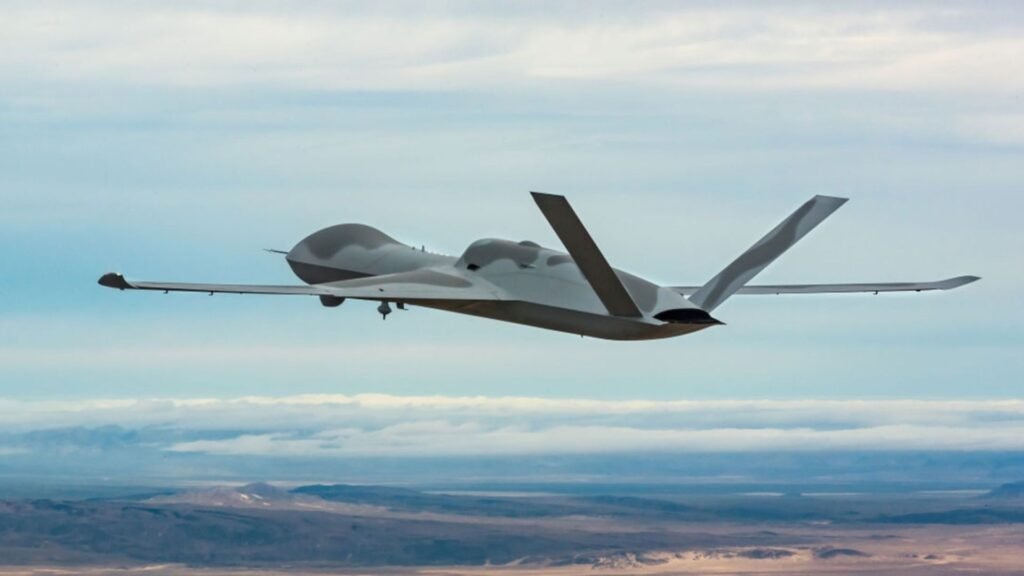
In a recent test at Edwards Air Force Base in California, a human-piloted F-22 Raptor teamed with General Atomics’ MQ-20 Avenger unmanned aircraft.
The aircraft coordinated through advanced autonomy software and a secure tactical data link, according to a Feb. 23 company release.
The exercise highlighted how the service plans to integrate Collaborative Combat Aircraft, or CCAs, into frontline fighter operations.
Live teaming at Edwards
The demonstration featured a manned F-22 issuing real-time commands to the MQ-20 during flight.
The Raptor served as the command aircraft, with its onboard pilot directing the unmanned jet through government reference autonomy software.
The MQ-20 responded by executing waypoint changes, combat air patrol patterns, and simulated airborne threat engagements.
It also exchanged tactical messages with the F-22 in a continuous command loop.
General Atomics equipped the MQ-20 with its Autonodyne Bashi Pilot Vehicle Interface.
That interface allowed the F-22 to send autonomy commands directly to the unmanned jet.
The system directed the MQ-20 to adjust waypoints, perform CAP missions, and carry out airborne threat engagement tasks.
Onboard sensors on the Avenger processed information independently. The aircraft coordinated maneuvers while following commands from the F-22 pilot.
“We appreciate the flawless execution of this mission using the government’s advanced autonomous systems,” said General Atomics President David R. Alexander.
“This demo featured the integration of mission elements and the ability of autonomy to utilize onboard sensors to make independent decisions and execute commands from the F-22.”
The test underscored the Air Force’s goal of keeping a human in command while delegating tactical tasks to autonomous systems.
Autonomy architecture validated
The Edwards flight builds on the Air Force‘s broader autonomy roadmap.
On Feb. 12, the service announced validation of its Autonomy Government Reference Architecture, known as A-GRA, across multiple vendors.
That milestone included integration of Collins Aerospace’s Sidekick software on General Atomics’ YFQ-42A Collaborative Combat Aircraft.
The aircraft completed its first semi-autonomous airborne mission under the program.
In a separate Feb. 23 release, the Air Force confirmed the YFQ-42A’s official nickname, “Dark Merlin.” (MilitaryTimes)
The aircraft flew for more than four hours under ground operator control. The mission validated reliable data exchange and autonomy execution.
Those results support advanced manned-unmanned teaming concepts like the MQ-20 and F-22 demonstration.
General Atomics has used the MQ-20 Avenger as a surrogate CCA for more than five years.
The company continues to mature purpose-built platforms, including the XQ-67A and YFQ-42A.
The Air Force sees CCAs as force multipliers for fifth-generation fighters.
By pairing crewed aircraft with autonomous drones, the service aims to extend sensor reach, increase lethality, and improve survivability in contested environments.
Under this model, pilots retain command authority for complex decisions. Autonomous aircraft handle high-risk or repetitive tactical tasks.
The Edwards demonstration marks another step toward operationalizing that vision.
🔗 Sumber: interestingengineering.com
📌 TOPINDIATOURS Update ai: Railway secures $100 million to challenge AWS with AI-n
Railway, a San Francisco-based cloud platform that has quietly amassed two million developers without spending a dollar on marketing, announced Thursday that it raised $100 million in a Series B funding round, as surging demand for artificial intelligence applications exposes the limitations of legacy cloud infrastructure.
TQ Ventures led the round, with participation from FPV Ventures, Redpoint, and Unusual Ventures. The investment values Railway as one of the most significant infrastructure startups to emerge during the AI boom, capitalizing on developer frustration with the complexity and cost of traditional platforms like Amazon Web Services and Google Cloud.
"As AI models get better at writing code, more and more people are asking the age-old question: where, and how, do I run my applications?" said Jake Cooper, Railway's 28-year-old founder and chief executive, in an exclusive interview with VentureBeat. "The last generation of cloud primitives were slow and outdated, and now with AI moving everything faster, teams simply can't keep up."
The funding is a dramatic acceleration for a company that has charted an unconventional path through the cloud computing industry. Railway raised just $24 million in total before this round, including a $20 million Series A from Redpoint in 2022. The company now processes more than 10 million deployments monthly and handles over one trillion requests through its edge network — metrics that rival far larger and better-funded competitors.
Why three-minute deploy times have become unacceptable in the age of AI coding assistants
Railway's pitch rests on a simple observation: the tools developers use to deploy and manage software were designed for a slower era. A standard build-and-deploy cycle using Terraform, the industry-standard infrastructure tool, takes two to three minutes. That delay, once tolerable, has become a critical bottleneck as AI coding assistants like Claude, ChatGPT, and Cursor can generate working code in seconds.
"When godly intelligence is on tap and can solve any problem in three seconds, those amalgamations of systems become bottlenecks," Cooper told VentureBeat. "What was really cool for humans to deploy in 10 seconds or less is now table stakes for agents."
The company claims its platform delivers deployments in under one second — fast enough to keep pace with AI-generated code. Customers report a tenfold increase in developer velocity and up to 65 percent cost savings compared to traditional cloud providers.
These numbers come directly from enterprise clients, not internal benchmarks. Daniel Lobaton, chief technology officer at G2X, a platform serving 100,000 federal contractors, measured deployment speed improvements of seven times faster and an 87 percent cost reduction after migrating to Railway. His infrastructure bill dropped from $15,000 per month to approximately $1,000.
"The work that used to take me a week on our previous infrastructure, I can do in Railway in like a day," Lobaton said. "If I want to spin up a new service and test different architectures, it would take so long on our old setup. In Railway I can launch six services in two minutes."
Inside the controversial decision to abandon Google Cloud and build data centers from scratch
What distinguishes Railway from competitors like Render and Fly.io is the depth of its vertical integration. In 2024, the company made the unusual decision to abandon Google Cloud entirely and build its own data centers, a move that echoes the famous Alan Kay maxim: "People who are really serious about software should make their own hardware."
"We wanted to design hardware in a way where we could build a differentiated experience," Cooper said. "Having full control over the network, compute, and storage layers lets us do really fast build and deploy loops, the kind that allows us to move at 'agentic speed' while staying 100 percent the smoothest ride in town."
The approach paid dividends during recent widespread outages that affected major cloud providers — Railway remained online throughout.
This soup-to-nuts control enables pricing that undercuts the hyperscalers by roughly 50 percent and newer cloud startups by three to four times. Railway charges by the second for actual compute usage: $0.00000386 per gigabyte-second of memory, $0.00000772 per vCPU-second, and $0.00000006 per gigabyte-second of storage. There are no charges for idle virtual machines — a stark contrast to the traditional cloud model where customers pay for provisioned capacity whether they use it or not.
"The conventional wisdom is that the big guys have economies of scale to offer better pricing," Cooper noted. "But when they're charging for VMs that usually sit idle in the cloud, and we've purpose-built everything to fit much more density on these machines, you have a big opportunity."
How 30 employees built a platform generating tens of millions in annual revenue
Railway has achieved its scale with a team of just 30 employees generating tens of millions in annual revenue — a ratio of revenue per employee that would be exceptional even for established software companies. The company grew revenue 3.5 times last year and continues to expand at 15 percent month-over-month.
Cooper emphasized that the fundraise was strategic rather than necessary. "We're default alive; there's no reason for us to raise money," he said. "We raised because we see a massive opportunity to accelerate, not because we needed to survive."
The company hired its first salesperson only last year and employs just two solutions engineers. Nearly all of Railway's two million users discovered the platform through word of mouth — developers telling other developers about a tool that actually works.
"We basically did the standard engineering thing: if you build it, they will come," Cooper recalled. "And to some degree, they came."
From side projects to Fortune 500 deployments: Railway's unlikely corporate expansion
Despite its grassroots developer community, Railway has made significant inroads into large organizations. The company claims that 31 percent of Fortune 500 companies now use its platform, though deployments range from company-wide infrastructure to individual team projects.
Notable customers include Bilt, the loyalty program company; Intuit's GoCo subsidiary; TripAdvisor's Cruise Critic; and MGM Resorts. Kernel, a Y Combinator-backed startup providing AI infrastructure to over 1,000 companies, runs its entire customer-facing system on Railway for $444 per month.
"At my previous company Clever, which sold …
Konten dipersingkat otomatis.
🔗 Sumber: venturebeat.com
🤖 Catatan TOPINDIATOURS
Artikel ini adalah rangkuman otomatis dari beberapa sumber terpercaya. Kami pilih topik yang sedang tren agar kamu selalu update tanpa ketinggalan.
✅ Update berikutnya dalam 30 menit — tema random menanti!