
📌 TOPINDIATOURS Update ai: Japanese supercomputer challenges 45-year-old theory ab
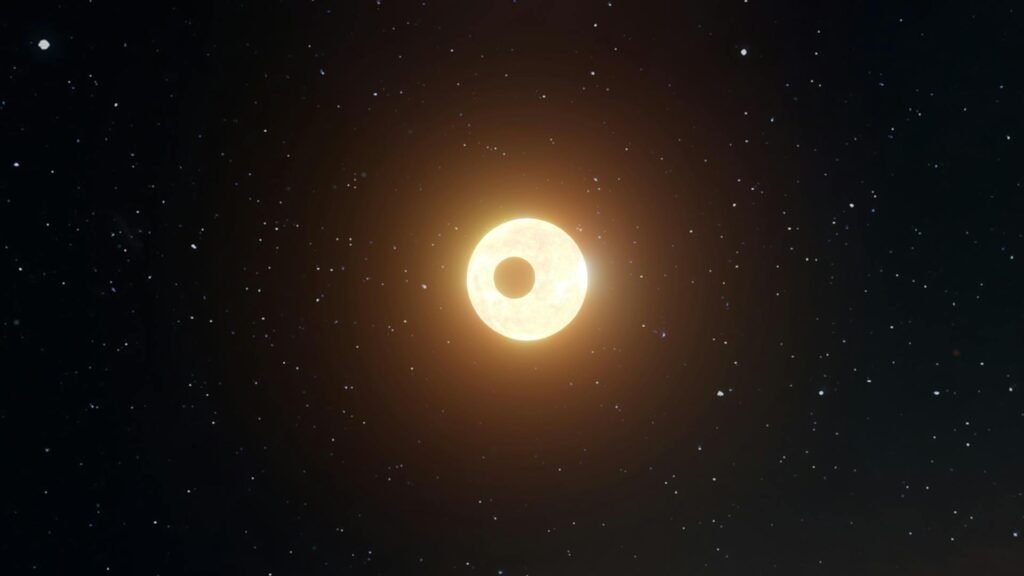
For nearly half a century, astronomers have believed that stars like our sun eventually change the way they rotate. The theory suggested that when such stars grow old and slow down, their rotation pattern flips—causing their poles to spin faster than their equators.
However, a new study from scientists at Nagoya University in Japan now suggests that this long-standing picture may be wrong. By running the most detailed simulations of stellar interiors ever performed, the researchers found that sun-like stars may keep the same rotation pattern for their entire lives.
“The simulation can reproduce the sun’s observed rotation pattern almost perfectly. When we apply it to slower-rotating stars, it also matches astronomical observations and shows no anti-solar rotation,” Yoshiki Hatta, study co-author and a professor at NU, said.
Instead of flipping to the predicted anti-solar rotation, the equator continues to rotate faster than the poles even when the star becomes very slow. These findings indicate that magnetic fields inside stars play a much larger role in shaping their behavior than earlier models suggested.
Why scientists expect stars to flip their rotation
Unlike Earth, which spins as a rigid body, stars are made of extremely hot, moving gas. This means different parts of a star can rotate at different speeds—a phenomenon called differential rotation.
In our sun, for example, the equator completes one rotation in roughly 25 days, while the polar regions take about 35 days. Scientists had long assumed that this pattern would eventually change as stars age. This is mainly because over billions of years, stars gradually lose rotational speed.
Earlier theoretical studies suggested that slower rotation would alter the movement of gas deep inside the star. Those internal flows were expected to reorganize in a way that would make the poles spin faster than the equator—a state known as anti-solar differential rotation.
However, there was a problem. Astronomers have never clearly observed such stars. The predicted rotation pattern appeared in computer models, but real observations failed to confirm it.
To investigate the discrepancy, researchers turned to powerful numerical simulations. The team built an extremely detailed model of the interior of solar-type stars using magnetohydrodynamic simulations, which simultaneously calculate the motion of hot plasma and the behavior of magnetic fields.
High-resolution simulations reveal the hidden role of magnetism
The calculations were carried out on Fugaku, one of the most powerful supercomputers in the world. The simulation was extraordinarily detailed. Each modeled star was divided into about 5.4 billion grid points, allowing scientists to track tiny turbulent motions and magnetic structures inside the stellar interior.
This level of detail turned out to be essential. Earlier simulations used far fewer grid points, which caused magnetic fields to weaken artificially during the calculations. Due to this limitation, earlier studies underestimated how important magnetism might be in shaping stellar rotation.
When the new high-resolution simulation was run, the magnetic fields remained strong and stable. The results revealed that magnetic forces together with turbulent gas motions keep the equator rotating faster than the poles, even when the star rotates very slowly.
“We found that these two processes, turbulence and magnetism, keep the equator spinning faster than the poles throughout the star’s life, not just when the star is young. So even though stars do slow down, the switch doesn’t happen because magnetic fields, which previous simulations missed, prevent it,” Hideyuki Hotta, one of the lead researchers and a professor at Nagoya, said.
The model also reproduced the sun’s observed rotation pattern with remarkable accuracy. When researchers applied the same simulation to stars rotating more slowly than the sun, the rotation pattern still did not flip. Instead, it remained solar-like.
This provides a possible explanation for why astronomers have struggled to find evidence of anti-solar rotation in real stars. The simulations also uncovered another trend. As a star ages, its magnetic field steadily weakens.
Earlier theories suggested the magnetic field might become strong again when the rotation pattern reversed, but the new results show no such revival. “Our results show that the magnetic field monotonically decreases over the stellar lifetime,” the study authors note.
Rethinking stellar evolution and magnetic activity
If confirmed, these findings could significantly change how astronomers understand the life cycles of stars. Stellar rotation influences many processes, including magnetic activity and the emission of energetic particles.
A better picture of these processes could also improve predictions about how stellar environments affect the planets orbiting them—especially whether those planets remain suitable for life over billions of years.
At the same time, the new results are based on simulations rather than direct measurements. Observing the internal rotation of distant stars remains extremely challenging. Future research will likely test these predictions using improved astronomical observations.
The study is published in the journal Nature Astronomy.
🔗 Sumber: interestingengineering.com
📌 TOPINDIATOURS Update ai: Salesforce rolls out new Slackbot AI agent as it battle
Salesforce on Tuesday launched an entirely rebuilt version of Slackbot, the company's workplace assistant, transforming it from a simple notification tool into what executives describe as a fully powered AI agent capable of searching enterprise data, drafting documents, and taking action on behalf of employees.
The new Slackbot, now generally available to Business+ and Enterprise+ customers, is Salesforce's most aggressive move yet to position Slack at the center of the emerging "agentic AI" movement — where software agents work alongside humans to complete complex tasks. The launch comes as Salesforce attempts to convince investors that artificial intelligence will bolster its products rather than render them obsolete.
"Slackbot isn't just another copilot or AI assistant," said Parker Harris, Salesforce co-founder and Slack's chief technology officer, in an exclusive interview with Salesforce. "It's the front door to the agentic enterprise, powered by Salesforce."
From tricycle to Porsche: Salesforce rebuilt Slackbot from the ground up
Harris was blunt about what distinguishes the new Slackbot from its predecessor: "The old Slackbot was, you know, a little tricycle, and the new Slackbot is like, you know, a Porsche."
The original Slackbot, which has existed since Slack's early days, performed basic algorithmic tasks — reminding users to add colleagues to documents, suggesting channel archives, and delivering simple notifications. The new version runs on an entirely different architecture built around a large language model and sophisticated search capabilities that can access Salesforce records, Google Drive files, calendar data, and years of Slack conversations.
"It's two different things," Harris explained. "The old Slackbot was algorithmic and fairly simple. The new Slackbot is brand new — it's based around an LLM and a very robust search engine, and connections to third-party search engines, third-party enterprise data."
Salesforce chose to retain the Slackbot brand despite the fundamental technical overhaul. "People know what Slackbot is, and so we wanted to carry that forward," Harris said.
Why Anthropic's Claude powers the new Slackbot — and which AI models could come next
The new Slackbot runs on Claude, Anthropic's large language model, a choice driven partly by compliance requirements. Slack's commercial service operates under FedRAMP Moderate certification to serve U.S. federal government customers, and Harris said Anthropic was "the only provider that could give us a compliant LLM" when Slack began building the new system.
But that exclusivity won't last. "We are, this year, going to support additional providers," Harris said. "We have a great relationship with Google. Gemini is incredible — performance is great, cost is great. So we're going to use Gemini for some things." He added that OpenAI remains a possibility as well.
Harris echoed Salesforce CEO Marc Benioff's view that large language models are becoming commoditized: "You've heard Marc talk about LLMs are commodities, that they're democratized. I call them CPUs."
On the sensitive question of training data, Harris was unequivocal: Salesforce does not train any models on customer data. "Models don't have any sort of security," he explained. "If we trained it on some confidential conversation that you and I have, I don't want Carolyn to know — if I train it into the LLM, there is no way for me to say you get to see the answer, but Carolyn doesn't."
Inside Salesforce's internal experiment: 80,000 employees tested Slackbot with striking results
Salesforce has been testing the new Slackbot internally for months, rolling it out to all 80,000 employees. According to Ryan Gavin, Slack's chief marketing officer, the results have been striking: "It's the fastest adopted product in Salesforce history."
Internal data shows that two-thirds of Salesforce employees have tried the new Slackbot, with 80% of those users continuing to use it regularly. Internal satisfaction rates reached 96% — the highest for any AI feature Slack has shipped. Employees report saving between two and 20 hours per week.
The adoption happened largely organically. "I think it was about five days, and a Canvas was developed by our employees called 'The Most Stealable Slackbot Prompts,'" Gavin said. "People just started adding to it organically. I think it's up to 250-plus prompts that are in this Canvas right now."
Kate Crotty, a principal UX researcher at Salesforce, found that 73% of internal adoption was driven by social sharing rather than top-down mandates. "Everybody is there to help each other learn and communicate hacks," she said.
How Slackbot transforms scattered enterprise data into executive-ready insights
During a product demonstration, Amy Bauer, Slack's product experience designer, showed how Slackbot can synthesize information across multiple sources. In one example, she asked Slackbot to analyze customer feedback from a pilot program, upload an image of a usage dashboard, and have Slackbot correlate the qualitative and quantitative data.
"This is where Slackbot really earns its keep for me," Bauer explained. "What it's doing is not just simply reading the image — it's actually looking at the image and comparing it to the insight it just generated for me."
Slackbot can then query Salesforce to find enterprise accounts with open deals that might be good candidates for early access, creating what Bauer called "a really great justification and plan to move forward." Finally, it can synthesize all that information into a Canvas — Slack's collaborative document format — and find calendar availability among stakeholders to schedule a review meeting.
"Up until this point, we have been working in a one-to-one capacity with Slackbot," Bauer said. "But one of the benefits that I can do now is take this insight and have it generate this into a Canvas, a shared workspace where I can iterate on it, refine it with Slackbot, or share it out with my team."
Rob Seaman, Slack's chief product officer, said the Canvas creation demonstrates where the product is heading: "This is making a tool call internally to Slack Canvas to actually write, effectively, a shared document. But it signals where we're going with Slackbot — we're eventually going to be adding in additional third-party tool calls."
MrBeast's company became a Slackbot guinea pig—and employees say they're saving 90 minutes a day
Among Salesforce's pilot customers is Beast Industries, the parent company of YouTube star MrBeast. Luis Madrigal, the company's chief information officer, joined the launch announcement to describe his experience.
"As somebody who has rolled out enterprise technologies for over two decades now, this was practically one of the easiest," Madrigal …
Konten dipersingkat otomatis.
🔗 Sumber: venturebeat.com
🤖 Catatan TOPINDIATOURS
Artikel ini adalah rangkuman otomatis dari beberapa sumber terpercaya. Kami pilih topik yang sedang tren agar kamu selalu update tanpa ketinggalan.
✅ Update berikutnya dalam 30 menit — tema random menanti!
