
📌 TOPINDIATOURS Eksklusif ai: Watch: Engineer kicks humanoid robot, yanks it by ne
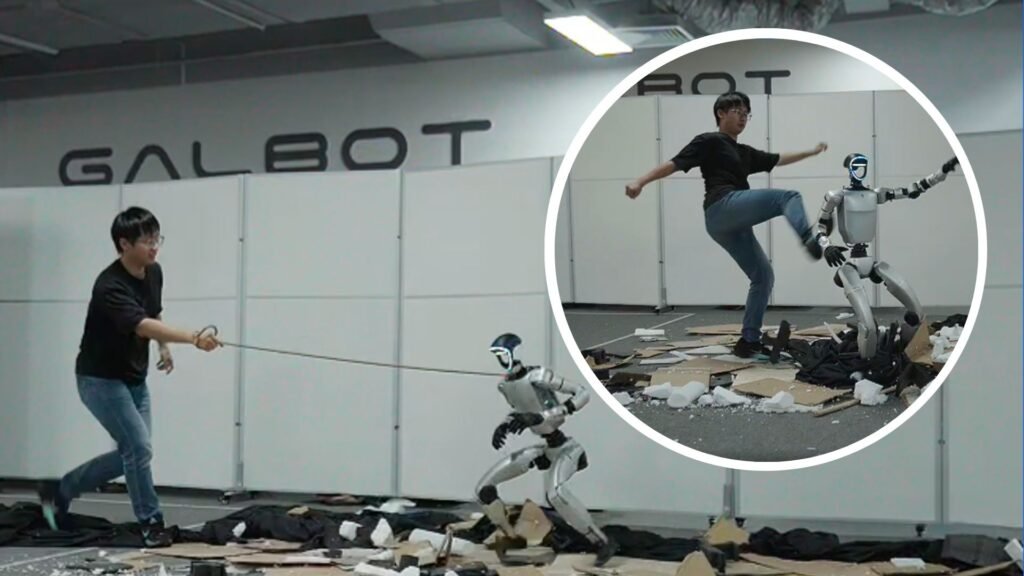
An engineer recently wrapped a chain around a humanoid robot’s neck and violently yanked it. The video of the incident was shared on multiple social media platforms. The clip shows a humanoid robot struggling to maintain balance as the engineer pulls the machine forcefully.
The footage demonstrates how a humanoid robot can stay upright even in challenging conditions. The robot featured in the video is the Unitree G1 humanoid.
The incident was originally meant to test the robot’s ability to respond to multiple external disturbances.
A test of humanoid motion tracker
Zhikai Zhang, a Tsinghua University PhD student, had made the video. Zhang was testing the Any2Track system, a humanoid motion tracker. The system tracks any motions under any disturbances.
The two-stage RL framework reformulates dynamics adaptability as an additional capability on top of basic action execution and consists of two key components: AnyTracker and AnyAdapter.
The researcher revealed that they deployed Any2Track on Unitree G1 hardware and achieved a successful sim2real transfer in a zero-shot manner. Any2Track performs exceptionally well in tracking various motions under multiple real-world disturbances.
Engineer kicks humanoid robot’s torso
The engineer is also seen kicking the humanoid robot’s torso violently.
The framework’s AnyTracker is a general motion tracker with careful designs to track various motions within a single policy. AnyAdapter is a history-informed adaptation module that endows the tracker with online dynamics adaptability to overcome the sim2real gap and multiple real-world disturbances.
Zhang developed the system in collaboration with Chinese robotics company Galbot, the same firm that recently opened a robot-run bodega.
Engineers have expressed that the foundational humanoid motion tracker is expected to be able to track diverse, highly dynamic, and contact-rich motions. More importantly, for general practical use, it must operate stably in real-world scenarios against various dynamic disturbances, including terrains, external forces, and physical property changes.
G1 humanoid robot shows remarkable capability.
Unitree G1 humanoid robot can maintain its balance against external disturbances.
In January, Unitree showcased its G1 robot’s smooth walking and running system, demonstrating agility, stability, and precise control on inclines and uneven terrain.
Unitree’s G1 humanoid previously also performed amazing kung-fu movements with amazing balance, albeit it almost trips once. The G1 exhibits remarkable coordination and flexibility with 23 degrees of freedom (DoF) and enhanced stability.
Unitree claims that the G1 is made to handle difficult, filthy, and repetitive jobs in a variety of settings, including at homes, factories, and hospitals. It embodies Unitree’s concept of humanoid robots serving as useful work and life companions.
Possessing a stable gait and highly flexible movement capabilities, the robot can walk and run autonomously in complex terrains and environments.
Equipped with 3D LiDAR + depth camera, the robot offers real-time acquisition of high-precision spatial data to achieve panoramic scanning.
🔗 Sumber: interestingengineering.com
📌 TOPINDIATOURS Update ai: DARPA Going Hard on Insect-Sized Spy Robots Edisi Jam 1
Forget robot wolves and missile-deflecting satellites — those things are already becoming old news. Instead, future wars just might revolve around insect-size spy robots.
A recent digest of present-day microbots by US national security magazine The National Interest breaks down the many machines currently in development by the US military and its associates. They include sea-based microdrones, cockroach-style surveillance bots, and even cyborg insects.
Arguably the most refined program to date is the RoboBee, currently being shopped by Harvard’s Wyss Institute. Originally funded by a $9.3 million grant from the National Science Foundation in 2009, the RoboBee is a bug-sized autonomous flying vehicle capable of transitioning from water to air, perching on surfaces, and autonomous collision avoidance in swarms.
The RoboBee features two “wafer-thin” wings that flap some 120 times a second to achieve vertical takeoff and mid-air hovering. The US Defense Advanced Research Projects Agency (DARPA) has reportedly taken a keen interest in RoboBee prototypes, sponsoring research into microfabrication technology, presumably for quick field deployments.
In the future, the little bots may very well carry payloads of monitoring equipment like microphones and cameras, though that’s easier said than done at such a minute scale.
Other developments, like the aforementioned cyborg insect, remain in early stages. Researchers have successfully demonstrated the capabilities of these remote-control systems using of a range of insect hosts, from the unicorn beetle to the humble cockroach.
Though DARPA has been funding insect-machine technology since 2006, their practical application is up in the air. Still, researchers are trying to keep up with the times, looking into ways to tune drone swarming algorithms to fit their cyborg creations.
Underwater microrobotics are another area of interest for DARPA. In this case, the application is said to be less mobile, instead focusing on clandestine monitoring of vulnerable underwater infrastructure.
The Interest also points to an alleged “robo-jelly” the agency has in the works, a soft-bodied autonomous drone which can silently glide through coastal waters. How practical this is remains to be seen — jellyfish are notorious drifters, following the ebbs and flows of coastal tides and deep ocean currents.
Last is the cockroach bot, the Dynamic Autonomous Sprawled Hexapod (DASH) in the works at DARPA’s notorious proving grounds at UC Berkeley. A white paper released by UC Berkeley back in 2009 defines DASH as a 16 gram, 10cm long autonomous robot which maneuvers via six legs powered by a single motor. It’s also capable of surmounting steps greater than its own height, and absorbing significant blows, including falls “from any height.”
According to the Interest, DASH is being developed with an eye toward crush resistance implying a quality-over-quantity approach compared to more agile systems like the RoboBee.
With so many bug-inspired robots coming down the pipeline, not to mention R&D grant money in the mix, it’s probably only a matter of time before at least some of the units make their way out of the lab and into the hands of a three-letter agency — if they haven’t already, that is.
More on microbots: Chinese Military Shows Off Fly-Sized Drones for Covert Ops
The post DARPA Going Hard on Insect-Sized Spy Robots appeared first on Futurism.
🔗 Sumber: futurism.com
🤖 Catatan TOPINDIATOURS
Artikel ini adalah rangkuman otomatis dari beberapa sumber terpercaya. Kami pilih topik yang sedang tren agar kamu selalu update tanpa ketinggalan.
✅ Update berikutnya dalam 30 menit — tema random menanti!
