📌 TOPINDIATOURS Hot ai: Perovskite-silicon triple-junction solar cells achieve rec
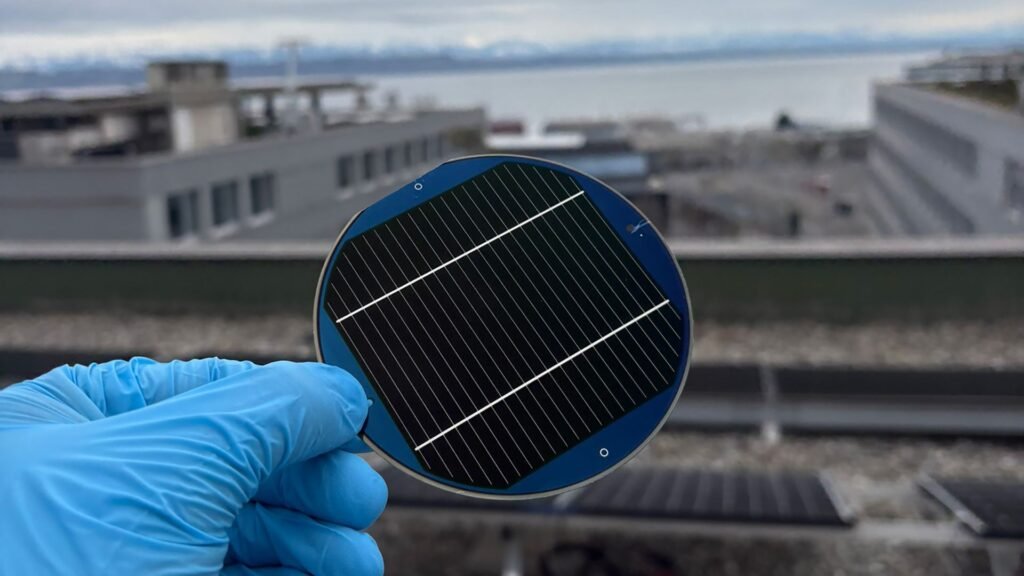
The previous solar efficiency record has now been broken, and this one could have real-world impact. Researchers at EPFL and CSEM have developed a triple-junction solar cell with a certified efficiency of 30.02%.
That pushes past the earlier 27.1% mark and puts a new spotlight on scalable, high-performance designs.
Most record-setting solar cells stay limited to expensive materials or lab conditions.
This device takes a different route. It combines a silicon bottom cell with two perovskite layers built as thin films.
The goal is clear: deliver higher efficiency without making manufacturing impractical.
Record meets real-world
Solar breakthroughs often struggle to move beyond prototypes.
This result stands out because it targets both performance and scalability.
Kerem Artuk, the study’s first author, explained the significance.
“We show that with clever design and processing, we can approach performance levels traditionally reserved for the most expensive III–V multi-junction solar cells used in space, which are composed of multiple semiconductor layers.”
He added that these cells “can reach up to 37% efficiency, and cost around 1,000 times more than terrestrial cells per watt.”
“Our approach opens the door to a new generation of industrially viable, high-efficiency multi-junction photovoltaics.”
That distinction matters for the US solar market. Higher efficiency reduces the number of panels needed for the same output. It also improves returns for both rooftop and utility-scale projects.
Fixing known weak spots
Triple-junction designs promise strong performance, but they come with technical challenges.
The EPFL team focused on two key issues: low voltage in the top cell and weak current in the middle layer.
They introduced a molecule that improves how perovskite crystals form. This step reduces defects and raises voltage in the top cell to 1.4 volts under sunlight.
The middle layer uses a new three-step fabrication method. It improves absorption in the near-infrared range, which carries a large share of solar energy.
The team also added nanoparticles between layers. These particles reflect light back into the middle cell and increase current.
Christophe Ballif highlighted the pace of progress. “Our first demonstration in 2018 had only 13% efficiency, so reaching over 30% efficiency today in a triple-junction device is a remarkable achievement.”
He added, “Triple-junction solar cells have an even higher efficiency potential compared to single junction and tandem – well above 40%.”
Cost remains the biggest barrier for high-efficiency solar cells. III-V semiconductors deliver strong performance but remain too expensive for widespread use.
This new design uses silicon and perovskites, both more affordable and easier to scale.
That combination could make high-efficiency panels more viable across US homes and solar farms.
Christian Wolff pointed to the broader implications.
“This project illustrates the power of combining fundamental science with Swiss engineering know-how,” he said.
“By demonstrating that low-cost perovskite materials can approach the performance of the most advanced space-grade photovoltaics, this research sets a new benchmark for multi-junction photovoltaics.”
The team now plans to focus on durability and large-scale production. If those efforts succeed, this record could translate into practical solar deployments sooner than expected.
The study is published in the journal Nature.
🔗 Sumber: interestingengineering.com
📌 TOPINDIATOURS Hot ai: OpenAI taps AWS to scale AI tools across US agencies, incl
OpenAI has reportedly signed a new agreement with Amazon Web Services to expand the reach of its artificial intelligence tools across the U.S. government.
The deal allows federal agencies to access OpenAI’s models for both classified and unclassified work through AWS infrastructure.
The Information was the first to report the development.
Amazon Web Services has confirmed the partnership, marking a significant step in OpenAI’s push into federal deployments.
The move builds on OpenAI’s recent Pentagon contract and positions the company to serve a wider range of government customers.
Expanding federal AI access
The agreement enables AWS to offer OpenAI’s AI products across its existing government cloud ecosystem.
This includes environments such as AWS GovCloud and classified regions used for sensitive workloads.
Federal agencies already relying on AWS can now integrate OpenAI tools more easily into their operations.
OpenAI will retain control over how its models are deployed.
The company will decide which systems are available and set conditions for their use.
AWS must also notify OpenAI before onboarding highly sensitive customers, including intelligence agencies. OpenAI can impose additional safeguards depending on the deployment.
This structure allows OpenAI to scale distribution while maintaining oversight.
It also gives agencies a standardized path to adopt advanced AI tools without building new infrastructure.
Pentagon deal momentum
The AWS partnership follows closely behind OpenAI’s recent deal with the Department of Defense.
That contract will provide AI tools, including ChatGPT-based systems, to roughly 3 million defense personnel.
Although the Pentagon agreement is relatively small in revenue terms, it carries strategic weight.
Estimates suggest it will generate only millions of dollars over 15 months. However, it strengthens OpenAI’s credibility in high-security environments.
The timing also reflects shifting dynamics within the defense sector. The Pentagon recently distanced itself from Anthropic after labeling the company a supply chain risk.
The decision followed disagreements over usage limits tied to surveillance and autonomous weapons.
OpenAI moved quickly to secure the defense contract after that fallout. The AWS deal now extends that momentum across other federal agencies.
Enterprise credibility boost
Government contracts often act as a signal of trust for enterprise customers. By embedding its technology within AWS’s public sector offerings, OpenAI gains broader visibility and validation.
AWS already serves as a primary cloud provider for many U.S. agencies.
It has also invested heavily in AI infrastructure, including integrations with multiple model providers.
Adding OpenAI to that ecosystem strengthens its portfolio while increasing competition within its own platform.
The partnership also places OpenAI alongside rivals in environments where AWS has deep influence.
Anthropic, which has received significant investment from Amazon, remains tightly integrated into AWS services such as Bedrock.
OpenAI’s entry introduces a new dynamic within that same ecosystem.
At the same time, OpenAI continues to refine its broader strategy.
The company has shifted focus toward enterprise and developer tools, including security and testing capabilities for AI systems.
Recent efforts include integrating tools that simulate prompt injection attacks and expanding developer-focused security features.
While government deals may not drive immediate revenue at scale, they play a critical role in long-term positioning.
By combining Pentagon access with AWS distribution, OpenAI is building a foundation for deeper adoption across both public and private sectors.
🔗 Sumber: interestingengineering.com
🤖 Catatan TOPINDIATOURS
Artikel ini adalah rangkuman otomatis dari beberapa sumber terpercaya. Kami pilih topik yang sedang tren agar kamu selalu update tanpa ketinggalan.
✅ Update berikutnya dalam 30 menit — tema random menanti!