📌 TOPINDIATOURS Breaking ai: Elon Musk launches Terafab to power next-gen AI, resh
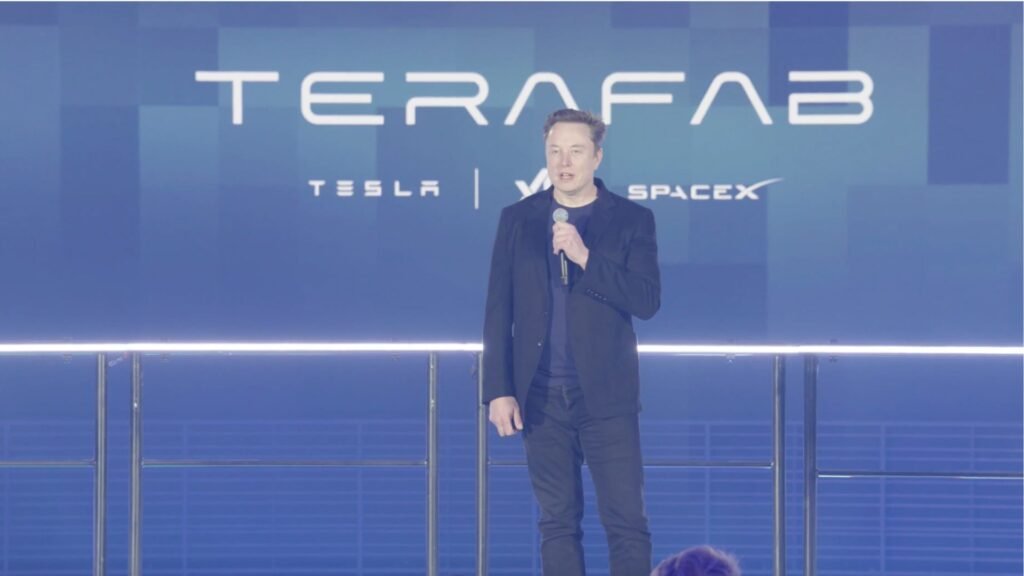
Elon Musk has unveiled an ambitious new initiative, the Terafab, aimed at transforming chip manufacturing through a joint effort between Tesla and SpaceX.
The project seeks to bring advanced semiconductor production in-house, reducing reliance on external suppliers.
Musk outlined a bold target of generating a terawatt—equivalent to one million megawatts—of compute capacity annually.
The announcement signals a major push to scale AI and hardware capabilities, positioning the venture at the forefront of next-generation computing infrastructure development.
In August 2025, Musk announced “Marcohard,” a tongue-in-cheek xAI project aiming to simulate Microsoft as a fully AI-driven software firm.
AI chip revolution
Musk has unveiled Terafab, a massive chip manufacturing initiative that could redefine the scale of global semiconductor production.
The project brings together Tesla, SpaceX, and xAI to build what is envisioned as the world’s largest chip factory under a single roof. xAI is a California-based AI startup that Musk’s space company acquired in February.
Terafab is designed to produce up to one trillion watts of compute annually, integrating logic, memory, and advanced packaging in a single facility. The effort targets a looming global shortage of high-performance chips, particularly those needed for AI, robotics, and large-scale infrastructure.
A key technological driver behind the project is space-based solar power. Musk outlined plans to deploy massive orbital systems capable of generating energy in space and transmitting it back to Earth. This would require launching tens of millions of tons of equipment annually—an unprecedented logistical and engineering challenge, reports Techeblog.
The initiative also aligns with Tesla’s Optimus humanoid robots, which are expected to operate and maintain orbital infrastructure. Their compute demands, along with those of AI-driven satellites, highlight the need for chip production at a scale far beyond current industry capacity, especially as shortages are projected to persist through the decade.
Orbital compute network
Elon Musk outlined a dual-chip strategy for the Terafab initiative, aimed at scaling AI and autonomous systems across Earth and space.
One class of chips will power Tesla Optimus and Tesla vehicles, supporting full autonomy. Musk emphasized that Optimus production could exceed car production by 10 to 100 times, driving massive chip demand, according to Business Insider.
The second chip, dubbed D3, is being developed specifically for space environments. It will support AI data centers in low Earth orbit, powered by solar energy. Musk argued that space-based AI could become cheaper than terrestrial systems due to constant sunlight and falling launch costs enabled by SpaceX.
Central to the concept is a distributed network of compact AI satellites, each generating around 100 kilowatts of power, with future versions expected to reach megawatt capacity. These systems would shift compute infrastructure off Earth, avoiding land and energy constraints.
Looking further ahead, Musk proposed establishing an industrial base on the Moon to unlock petawatt-scale computing—1,000 times greater than current terawatt ambitions. While acknowledging the speculative nature of these plans, he framed them as part of a long-term vision for abundant energy and computing resources, reports Business Insider.
🔗 Sumber: interestingengineering.com
📌 TOPINDIATOURS Eksklusif ai: Adobe Research Unlocking Long-Term Memory in Video W
Video world models, which predict future frames conditioned on actions, hold immense promise for artificial intelligence, enabling agents to plan and reason in dynamic environments. Recent advancements, particularly with video diffusion models, have shown impressive capabilities in generating realistic future sequences. However, a significant bottleneck remains: maintaining long-term memory. Current models struggle to remember events and states from far in the past due to the high computational cost associated with processing extended sequences using traditional attention layers. This limits their ability to perform complex tasks requiring sustained understanding of a scene.
A new paper, “Long-Context State-Space Video World Models” by researchers from Stanford University, Princeton University, and Adobe Research, proposes an innovative solution to this challenge. They introduce a novel architecture that leverages State-Space Models (SSMs) to extend temporal memory without sacrificing computational efficiency.
The core problem lies in the quadratic computational complexity of attention mechanisms with respect to sequence length. As the video context grows, the resources required for attention layers explode, making long-term memory impractical for real-world applications. This means that after a certain number of frames, the model effectively “forgets” earlier events, hindering its performance on tasks that demand long-range coherence or reasoning over extended periods.
The authors’ key insight is to leverage the inherent strengths of State-Space Models (SSMs) for causal sequence modeling. Unlike previous attempts that retrofitted SSMs for non-causal vision tasks, this work fully exploits their advantages in processing sequences efficiently.
The proposed Long-Context State-Space Video World Model (LSSVWM) incorporates several crucial design choices:
- Block-wise SSM Scanning Scheme: This is central to their design. Instead of processing the entire video sequence with a single SSM scan, they employ a block-wise scheme. This strategically trades off some spatial consistency (within a block) for significantly extended temporal memory. By breaking down the long sequence into manageable blocks, they can maintain a compressed “state” that carries information across blocks, effectively extending the model’s memory horizon.
- Dense Local Attention: To compensate for the potential loss of spatial coherence introduced by the block-wise SSM scanning, the model incorporates dense local attention. This ensures that consecutive frames within and across blocks maintain strong relationships, preserving the fine-grained details and consistency necessary for realistic video generation. This dual approach of global (SSM) and local (attention) processing allows them to achieve both long-term memory and local fidelity.
The paper also introduces two key training strategies to further improve long-context performance:
- Diffusion Forcing: This technique encourages the model to generate frames conditioned on a prefix of the input, effectively forcing it to learn to maintain consistency over longer durations. By sometimes not sampling a prefix and keeping all tokens noised, the training becomes equivalent to diffusion forcing, which is highlighted as a special case of long-context training where the prefix length is zero. This pushes the model to generate coherent sequences even from minimal initial context.
- Frame Local Attention: For faster training and sampling, the authors implemented a “frame local attention” mechanism. This utilizes FlexAttention to achieve significant speedups compared to a fully causal mask. By grouping frames into chunks (e.g., chunks of 5 with a frame window size of 10), frames within a chunk maintain bidirectionality while also attending to frames in the previous chunk. This allows for an effective receptive field while optimizing computational load.
The researchers evaluated their LSSVWM on challenging datasets, including Memory Maze and Minecraft, which are specifically designed to test long-term memory capabilities through spatial retrieval and reasoning tasks.
The experiments demonstrate that their approach substantially surpasses baselines in preserving long-range memory. Qualitative results, as shown in supplementary figures (e.g., S1, S2, S3), illustrate that LSSVWM can generate more coherent and accurate sequences over extended periods compared to models relying solely on causal attention or even Mamba2 without frame local attention. For instance, on reasoning tasks for the maze dataset, their model maintains better consistency and accuracy over long horizons. Similarly, for retrieval tasks, LSSVWM shows improved ability to recall and utilize information from distant past frames. Crucially, these improvements are achieved while maintaining practical inference speeds, making the models suitable for interactive applications.
The Paper Long-Context State-Space Video World Models is on arXiv
The post Adobe Research Unlocking Long-Term Memory in Video World Models with State-Space Models first appeared on Synced.
🔗 Sumber: syncedreview.com
🤖 Catatan TOPINDIATOURS
Artikel ini adalah rangkuman otomatis dari beberapa sumber terpercaya. Kami pilih topik yang sedang tren agar kamu selalu update tanpa ketinggalan.
✅ Update berikutnya dalam 30 menit — tema random menanti!