
📌 TOPINDIATOURS Update ai: Adobe Research Unlocking Long-Term Memory in Video Worl
Video world models, which predict future frames conditioned on actions, hold immense promise for artificial intelligence, enabling agents to plan and reason in dynamic environments. Recent advancements, particularly with video diffusion models, have shown impressive capabilities in generating realistic future sequences. However, a significant bottleneck remains: maintaining long-term memory. Current models struggle to remember events and states from far in the past due to the high computational cost associated with processing extended sequences using traditional attention layers. This limits their ability to perform complex tasks requiring sustained understanding of a scene.
A new paper, “Long-Context State-Space Video World Models” by researchers from Stanford University, Princeton University, and Adobe Research, proposes an innovative solution to this challenge. They introduce a novel architecture that leverages State-Space Models (SSMs) to extend temporal memory without sacrificing computational efficiency.
The core problem lies in the quadratic computational complexity of attention mechanisms with respect to sequence length. As the video context grows, the resources required for attention layers explode, making long-term memory impractical for real-world applications. This means that after a certain number of frames, the model effectively “forgets” earlier events, hindering its performance on tasks that demand long-range coherence or reasoning over extended periods.
The authors’ key insight is to leverage the inherent strengths of State-Space Models (SSMs) for causal sequence modeling. Unlike previous attempts that retrofitted SSMs for non-causal vision tasks, this work fully exploits their advantages in processing sequences efficiently.
The proposed Long-Context State-Space Video World Model (LSSVWM) incorporates several crucial design choices:
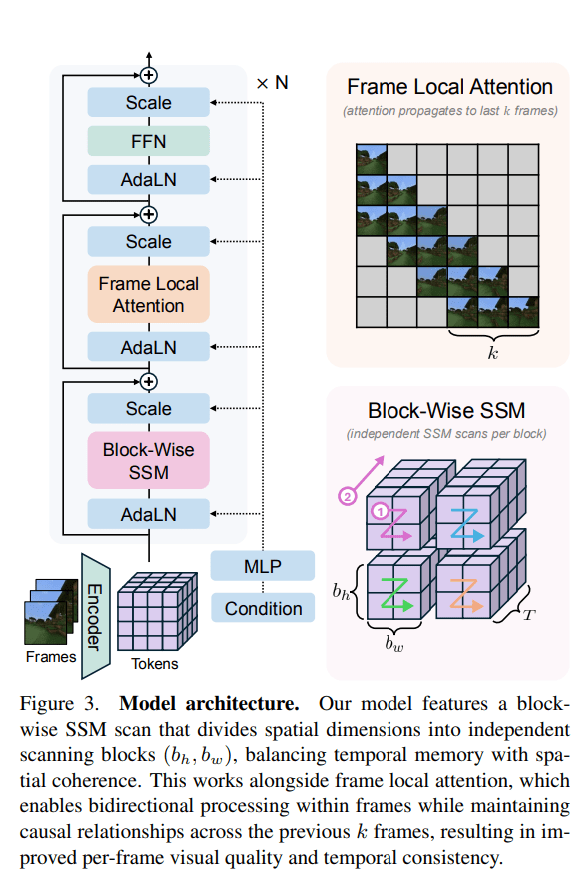
- Block-wise SSM Scanning Scheme: This is central to their design. Instead of processing the entire video sequence with a single SSM scan, they employ a block-wise scheme. This strategically trades off some spatial consistency (within a block) for significantly extended temporal memory. By breaking down the long sequence into manageable blocks, they can maintain a compressed “state” that carries information across blocks, effectively extending the model’s memory horizon.
- Dense Local Attention: To compensate for the potential loss of spatial coherence introduced by the block-wise SSM scanning, the model incorporates dense local attention. This ensures that consecutive frames within and across blocks maintain strong relationships, preserving the fine-grained details and consistency necessary for realistic video generation. This dual approach of global (SSM) and local (attention) processing allows them to achieve both long-term memory and local fidelity.
The paper also introduces two key training strategies to further improve long-context performance:
- Diffusion Forcing: This technique encourages the model to generate frames conditioned on a prefix of the input, effectively forcing it to learn to maintain consistency over longer durations. By sometimes not sampling a prefix and keeping all tokens noised, the training becomes equivalent to diffusion forcing, which is highlighted as a special case of long-context training where the prefix length is zero. This pushes the model to generate coherent sequences even from minimal initial context.
- Frame Local Attention: For faster training and sampling, the authors implemented a “frame local attention” mechanism. This utilizes FlexAttention to achieve significant speedups compared to a fully causal mask. By grouping frames into chunks (e.g., chunks of 5 with a frame window size of 10), frames within a chunk maintain bidirectionality while also attending to frames in the previous chunk. This allows for an effective receptive field while optimizing computational load.
The researchers evaluated their LSSVWM on challenging datasets, including Memory Maze and Minecraft, which are specifically designed to test long-term memory capabilities through spatial retrieval and reasoning tasks.
The experiments demonstrate that their approach substantially surpasses baselines in preserving long-range memory. Qualitative results, as shown in supplementary figures (e.g., S1, S2, S3), illustrate that LSSVWM can generate more coherent and accurate sequences over extended periods compared to models relying solely on causal attention or even Mamba2 without frame local attention. For instance, on reasoning tasks for the maze dataset, their model maintains better consistency and accuracy over long horizons. Similarly, for retrieval tasks, LSSVWM shows improved ability to recall and utilize information from distant past frames. Crucially, these improvements are achieved while maintaining practical inference speeds, making the models suitable for interactive applications.
The Paper Long-Context State-Space Video World Models is on arXiv
The post Adobe Research Unlocking Long-Term Memory in Video World Models with State-Space Models first appeared on Synced.
🔗 Sumber: syncedreview.com
📌 TOPINDIATOURS Hot ai: What killed Napoleon’s army? Scientists finally uncover th
In the summer of 1812, Napoleon Bonaparte led half a million soldiers into Russia. By the end of the year, only a fraction survived.
Historians have long blamed typhus, a deadly louse-borne disease, for the disaster. But new research suggests otherwise.
Scientists from the Institut Pasteur in France used advanced DNA analysis to reexamine the remains of Napoleon’s fallen troops.
They found no evidence of typhus. Instead, the soldiers carried bacteria that cause enteric fever and relapsing fever, two diseases that may have hastened the army’s downfall.
“It’s very exciting to use a technology we have today to detect and diagnose something that was buried for 200 years,” says lead author Nicolás Rascovan of the Institut Pasteur.
Rethinking historical mystery
For over two centuries, researchers have debated what wiped out Napoleon’s Grand Army during the failed invasion of Russia. Contemporary doctors and officers reported symptoms consistent with typhus.
The discovery of body lice and traces of Rickettsia prowazekii, the bacterium behind typhus, on remains found in past excavations further reinforced that belief.
However, the new study challenges this long-held assumption.
Rascovan’s team revisited samples taken from a mass grave in Vilnius, Lithuania, located along the French army’s retreat route.
Using advanced microbial paleogenomics, they extracted DNA from the teeth of 13 soldiers.
Teeth, which preserve biomolecules well, provided the most reliable source of ancient DNA.
After removing environmental contamination, the team sequenced and analyzed the genetic material.
What they found surprised them: there were no traces of R. prowazekii or Bartonella quintana, the bacterium behind trench fever.
Instead, two other pathogens emerged, Salmonella enterica and Borrelia recurrentis.
The first causes enteric fever, a group of illnesses that includes typhoid, while the second triggers relapsing fever, a louse-borne disease characterized by recurrent high fevers.
Ancient DNA tells deeper story
Earlier studies used polymerase chain reaction (PCR) to detect pathogens in ancient remains.
However, PCR works best when DNA is relatively intact. Ancient samples, degraded over centuries, often contain fragments too small for PCR to amplify.
“Ancient DNA gets highly degraded into pieces that are too small for PCR to work,” Rascovan explains.
“Our method is able to cast a wider net and capture a greater range of DNA sources based on these very short ancient sequences.”
The team’s broader sequencing approach not only identified the bacteria but also revealed a surprising evolutionary link.
The B. recurrentis strain found in Napoleon’s soldiers matched a lineage discovered in Iron Age Britain, dating back 2,000 years.
That ancient lineage somehow persisted in Europe for millennia before eventually being replaced by modern variants.
“This shows the power of ancient DNA technology to uncover the history of infectious diseases that we wouldn’t be able to reconstruct with modern samples,” says Rascovan.
The findings offer a new perspective on one of history’s most famous military disasters.
Instead of a single cause, multiple infectious diseases combined with hunger, exhaustion, and freezing conditions likely decimated Napoleon’s army as it retreated from Russia.
By applying cutting-edge DNA analysis to a 200-year-old mystery, researchers are shedding new light on what truly killed thousands of soldiers during one of the most brutal campaigns in history.
The study is published in the journal Current Biology.
🔗 Sumber: interestingengineering.com
🤖 Catatan TOPINDIATOURS
Artikel ini adalah rangkuman otomatis dari beberapa sumber terpercaya. Kami pilih topik yang sedang tren agar kamu selalu update tanpa ketinggalan.
✅ Update berikutnya dalam 30 menit — tema random menanti!
