
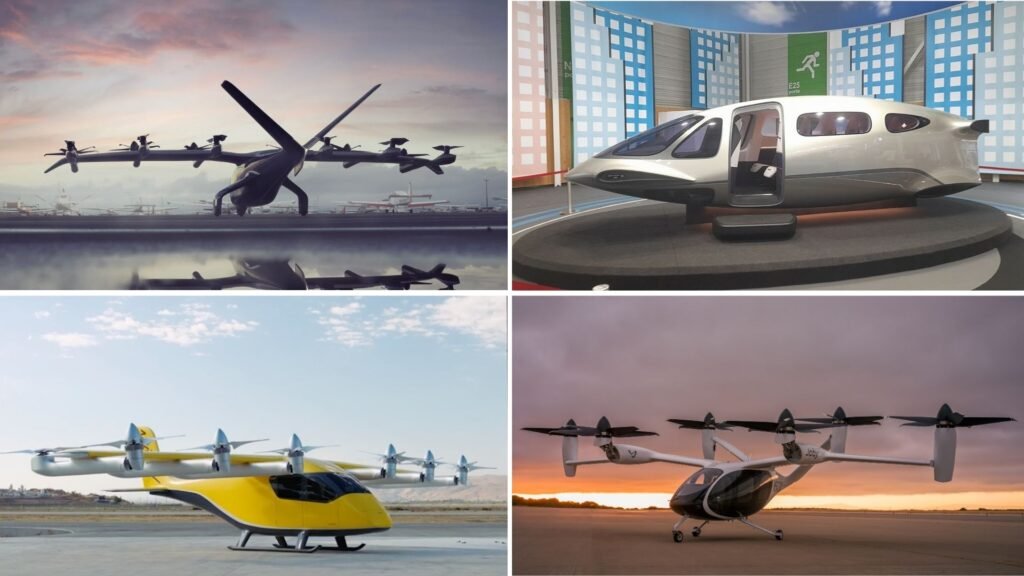
📌 TOPINDIATOURS Breaking ai: Top 5 innovative air taxis set to change how the worl
The autonomous air taxi industry is approaching a major milestone in 2026, with several companies pushing towards certification and commercial development. Urban air mobility is transitioning from conceptual testing to real-world operations, marking a pivotal shift for global transportation networks.
These innovators are shaping the infrastructure, partnerships, and regulatory pathways that will define aerial transportation in the years to come. Together, their efforts are signaling that autonomous air taxis will be amongst us soon, bringing a futuristic vision into solid reality.
1. S4 Aircraft – Joby Aviation
Joby Aviation has 54 of its aircarfts entering the final stages of Type Certification, making it the leader of the race toward FAA certification. Its S4 aircraft design can accommodate a pilot and four passengers, cruising at 200 mph with a 100-mile range including reserves. With six dual-wound electric motors producing 236 kWh each, the aircraft produces nearly double the output of a Tesla Model S Plaid.
By Q1 2026, Joby plans to launch commercial passenger flights in Dubai, followed by U.S. expansion later that year. A milestone point-to-point test flight in the UAE in November 2025 made Joby the first electric air taxi to operate in shared airspace. The company is also conducting power-on tests of its first FAA-conforming aircraft.
2. Midnight Aircraft – Archer Aviation
Archer Aviation is preparing for simultaneous global operations by securing critical FAA certifications and international regulatory support. Its Midnight aircraft features 12 rotors, seating one pilot and four passengers, and has demonstrated strong performance across speed, altitude, and endurance tests.
Midnight reaches a cruise speed of approximately 150 mph and supports missions of around 100 miles. It achieved a record-breaking 55-mile flight in 31 minutes and climbed 7,000 feet to show its operational range and flexibility.
Archer plans to launch passenger flights in Abu Dhabi in 2026, while continuing FAA certification efforts. Reports suggest Archer could begin commercial flight operations by early 2026.
3. VX4 Aircraft – Vertical Aerospace
Vertical Aerospace is pursuing a dual-technology approach with both all-electric and hybrid-electric versions of its VX4 aircraft. The all-electric aircraft aims for a 5-6 passenger capacity with a range of over 100 miles.
The company completed the first phase of piloted flight testing in 2024, accumulating extensive data across 20 flights and 70 test points.
With a payload capacity of 2,425 pounds (1,100 kg), the VX4 aircraft offers a range of 1,000 miles. Given its extended range, the aircraft is useful across multiple industries, including defense, healthcare, and long-distance logistics.
4. Lilium Jet
Lilium focuses on regional air mobility rather than short-hop urban routes, differentiating itself from most air taxi competitors. Its six-passenger Lilium Jet uses ducted-fan technology rather than open rotors, offering noise and efficiency advantages. The company expects its first customer deliveries in 2026, with manned flight planned for early 2025.
With parallel propulsion testing underway, thousands of data points are collected every second across multiple engines. Lilium will announce its launch market for 2026 by the end of 2024, positioning itself for immediate commercial activation upon certification.
The Lilium Jet cruises at up to 190 mph, depending on mission configuration and payload. Its winged body incorporates advanced transition technology, enabling smooth, efficient lift during cruise. Its aerodynamic design enhances range and payload capacity.
5. Wisk Aero Generation 6
Wisk Aero is the only company fully committed to autonomous passenger flight, developing the Generation 6 eVTOL as a four-seat, all-electric platform. With over 1,600 full-scale test flights, Wisk operates the industry’s largest and most mature autonomous test fleet.
The aircraft flies at 120 knots, ranges 90 miles with reserves, and cruises between 2,500 and 4,000 feet. Wisk’s design eliminates hydraulics, oil, and fuel systems, reducing failure points and simplifying maintenance. Its autonomous-first philosophy represents a fundamentally different vision for air taxi operations.
Conclusion
The shift toward commercial air taxi operations in 2026 marks one of the most significant transitions in modern transportation. Each of these five companies is shaping a different dimension of the future thorugh autonomy, regional mobility, or infrastructure integration.
As regulatory bodies advance certifications and global partners building ecosystems, the momentum continues to accelerate. What is clear, however, is that autonomous air taxis are on track to redefine how the world moves.
🔗 Sumber: interestingengineering.com
📌 TOPINDIATOURS Hot ai: Biologists unveil lifelong method to dial protein levels u
Researchers have long faced a blunt limitation in biology. They could delete proteins or switch genes off, but they could not finely tune how much of a protein existed in specific tissues over an animal’s lifetime.
That gap has slowed progress in understanding ageing and how organs influence one another at the molecular level.
Now, scientists have developed a method that allows precise, lifelong control of protein levels inside different tissues of a living animal.
The technique lets researchers increase or decrease proteins with calibration rather than force.
It opens new ways to study ageing, disease, and whole-body biological coordination.
Scientists at the Centre for Genomic Regulation in Barcelona and the University of Cambridge demonstrated the approach in the nematode worm Caenorhabditis elegans.
They adjusted protein levels in the animals’ intestines and neurons while the worms continued to live, eat, and grow normally.
The new method addresses a long-standing challenge in experimental biology.
Many existing tools remove proteins entirely or work only for short periods. Others fail to target specific tissues over an animal’s full lifespan.
These limits have made it difficult to study systemic processes like ageing. Ageing depends on constant communication between organs.
A protein may extend lifespan in one tissue but shorten it in another. Standard on-off genetic experiments often cannot separate these effects.
“No protein acts alone. Our new approach lets us study how multiple proteins in different tissues cooperate to control how the body functions and ages,” says Dr. Nicholas Stroustrup, researcher at the Centre for Genomic Regulation and senior author of the paper.
Researchers have also struggled to track how small molecular changes spread across the body over time.
Subtle shifts in protein levels can have outsized effects, but older tools lack the precision to measure them.
Turning proteins like volume
“To unpick nuance in biology, sometimes you need half the concentration of a protein here and a quarter there, but all we’ve had up till now are techniques focused on wiping a protein out,” explains Dr. Stroustrup.
“We wanted to be able to control proteins like you turn the volume up or down on a TV, and now we can now ask all sorts of new questions.”
The technique builds on a system originally developed from plant biology. Plants use a hormone called auxin to regulate growth. Scientists adapted this process into the auxin-inducible degron, or AID, system.
In the AID system, researchers tag a protein with a degron. An enzyme called TIR1 recognizes the tag and destroys the protein when auxin is present. When auxin disappears, the protein returns. Scientists widely use this system for rapid, reversible protein control.
However, the classic AID system mostly works like a switch. Proteins appear or disappear, with little control over dosage or location.
Dual-channel breakthrough
The research team engineered a more flexible version called a “dual-channel” AID system.
They created different versions of the TIR1 enzyme and matching degron tags. Each enzyme responds to a different auxin compound.
By placing these enzymes in different tissues, the scientists independently controlled the same protein in neurons and intestines.
They also controlled two different proteins at the same time. The team tested the system across more than 100,000 worms.
The researchers also solved a major hurdle.
Many AID systems fail in reproductive tissues. The team traced the issue to a biological process in the germline and modified their system to overcome it.
“Getting this to work was quite an engineering challenge. We had to test different combinations of synthetic switches to find the perfect pair that didn’t interfere with one another,” says Dr. Jeremy Vicencio, postdoctoral researcher at the Centre for Genomic Regulation and coauthor of the study.
“Now that we’ve cracked it, we can control two separate proteins simultaneously with incredible precision.”
The researchers say the tool could reshape studies of ageing and disease.
It allows scientists to ask how much protein is enough, when changes matter most, and how effects ripple across the body over time.
The study is published in the journal Nature Communications.
🔗 Sumber: interestingengineering.com
🤖 Catatan TOPINDIATOURS
Artikel ini adalah rangkuman otomatis dari beberapa sumber terpercaya. Kami pilih topik yang sedang tren agar kamu selalu update tanpa ketinggalan.
✅ Update berikutnya dalam 30 menit — tema random menanti!
