
📌 TOPINDIATOURS Eksklusif ai: Amazon’s robotaxis make risky intersection stops, pr
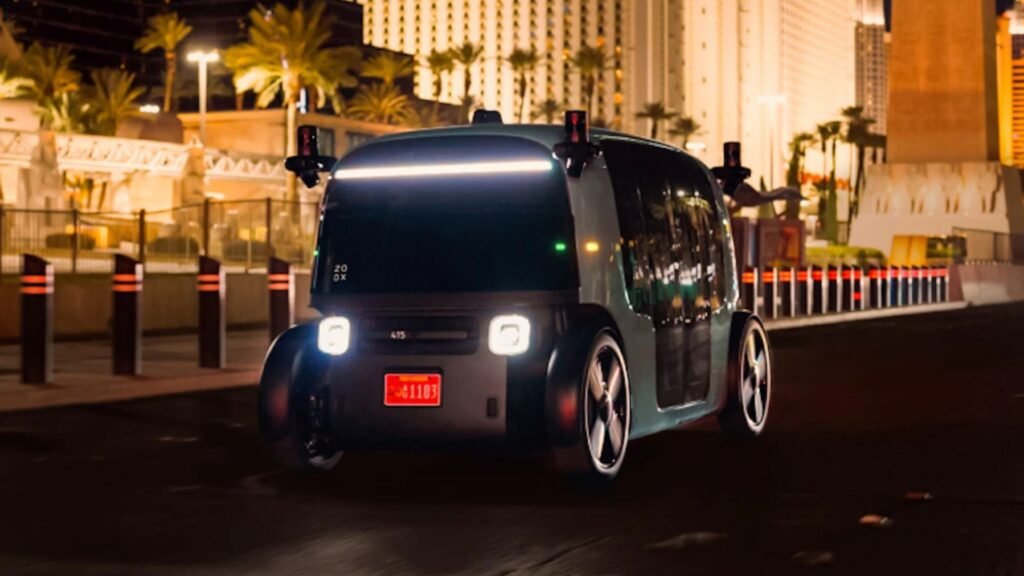
Amazon-owned autonomous vehicle company Zoox has announced a voluntary software recall after identifying driving behavior near intersections that could raise safety concerns, according to federal filings released Tuesday.
The recall applies to 332 driverless vehicles and involves software used by Zoox robotaxis operating on public roads.
The National Highway Traffic Safety Administration said the affected vehicles may cross yellow center lines, block crosswalks, or stop in front of oncoming traffic near intersections.
Zoox reported no crashes tied to the issue but acknowledged an increased risk.
Zoox currently runs public robotaxi services in parts of San Francisco and Las Vegas, where it offers free rides in fully autonomous vehicles.
Turning behavior reviewed
Zoox first detected the issue in late August after a robotaxi executed a wide right turn near an intersection. According to NHTSA documents, the vehicle crossed partially into the opposing lane and paused in front of oncoming traffic.
That incident prompted a broader internal review. Zoox analyzed driving data and identified 62 cases between August 26 and December 5 where vehicles crossed lane markings unnecessarily near intersections.
Some crossings were partial, while others extended fully into opposing lanes.
Zoox told regulators it remained engaged with federal officials throughout the review.
The company said it was in “ongoing conversations with NHTSA about the frequency, severity, and root causes of these occurrences.”
A Zoox spokesperson said the company identified driving actions that did not align with its internal safety standards.
In certain cases, robotaxis stopped inside crosswalks to avoid blocking intersections at red lights. In other situations, vehicles completed turns too late, resulting in wide maneuvers.
Software fixes applied
Zoox said it resolved the problem through software updates issued on November 7 and again in mid-December.
The recall documents those updates rather than requiring physical vehicle repairs.
“We have successfully identified and deployed targeted software improvements to address the root causes of these incidents,” the company said.
“Today, we’re submitting a voluntary software recall because transparency and safety is foundational to Zoox, and we want to be open with the public and regulators about how we are constantly refining and improving our technology.”
The recall covers Zoox vehicles that operated on public roads between March 13 and December 18.
The company said the updated software prevents the behaviors identified during the review.
The latest recall adds to a growing list of software fixes Zoox has issued this year.
In March, the company recalled vehicles after reports of unexpected hard braking.
That action followed two incidents where motorcyclists struck the rear of Zoox vehicles.
Zoox also issued recalls in May to improve how its system predicts the movement of pedestrians and other road users.
One update followed an April crash involving an unoccupied robotaxi and a passenger vehicle in Las Vegas.
Federal regulators have recently closed several probes involving Zoox.
The NHTSA ended a braking investigation in April and certified Zoox vehicles for demonstration use in August, closing a separate compliance probe that began in 2022.
Other autonomous vehicle developers face similar scrutiny.
Alphabet-owned Waymo recently recalled vehicles after Texas officials reported illegal school bus passings.
The NHTSA opened an investigation into that matter in October.
As autonomous services expand, regulators continue to monitor software performance closely, especially in complex urban traffic environments.
🔗 Sumber: interestingengineering.com
📌 TOPINDIATOURS Breaking ai: ByteDance Introduces Astra: A Dual-Model Architecture
The increasing integration of robots across various sectors, from industrial manufacturing to daily life, highlights a growing need for advanced navigation systems. However, contemporary robot navigation systems face significant challenges in diverse and complex indoor environments, exposing the limitations of traditional approaches. Addressing the fundamental questions of “Where am I?”, “Where am I going?”, and “How do I get there?”, ByteDance has developed Astra, an innovative dual-model architecture designed to overcome these traditional navigation bottlenecks and enable general-purpose mobile robots.
Traditional navigation systems typically consist of multiple, smaller, and often rule-based modules to handle the core challenges of target localization, self-localization, and path planning. Target localization involves understanding natural language or image cues to pinpoint a destination on a map. Self-localization requires a robot to determine its precise position within a map, especially challenging in repetitive environments like warehouses where traditional methods often rely on artificial landmarks (e.g., QR codes). Path planning further divides into global planning for rough route generation and local planning for real-time obstacle avoidance and reaching intermediate waypoints.
While foundation models have shown promise in integrating smaller models to tackle broader tasks, the optimal number of models and their effective integration for comprehensive navigation remained an open question.
ByteDance’s Astra, detailed in their paper “Astra: Toward General-Purpose Mobile Robots via Hierarchical Multimodal Learning” (website: https://astra-mobility.github.io/), addresses these limitations. Following the System 1/System 2 paradigm, Astra features two primary sub-models: Astra-Global and Astra-Local. Astra-Global handles low-frequency tasks like target and self-localization, while Astra-Local manages high-frequency tasks such as local path planning and odometry estimation. This architecture promises to revolutionize how robots navigate complex indoor spaces.
Astra-Global: The Intelligent Brain for Global Localization
Astra-Global serves as the intelligent core of the Astra architecture, responsible for critical low-frequency tasks: self-localization and target localization. It functions as a Multimodal Large Language Model (MLLM), adept at processing both visual and linguistic inputs to achieve precise global positioning within a map. Its strength lies in utilizing a hybrid topological-semantic graph as contextual input, allowing the model to accurately locate positions based on query images or text prompts.
The construction of this robust localization system begins with offline mapping. The research team developed an offline method to build a hybrid topological-semantic graph G=(V,E,L):
- V (Nodes): Keyframes, obtained by temporal downsampling of input video and SfM-estimated 6-Degrees-of-Freedom (DoF) camera poses, act as nodes encoding camera poses and landmark references.
- E (Edges): Undirected edges establish connectivity based on relative node poses, crucial for global path planning.
- L (Landmarks): Semantic landmark information is extracted by Astra-Global from visual data at each node, enriching the map’s semantic understanding. These landmarks store semantic attributes and are connected to multiple nodes via co-visibility relationships.
In practical localization, Astra-Global’s self-localization and target localization capabilities leverage a coarse-to-fine two-stage process for visual-language localization. The coarse stage analyzes input images and localization prompts, detects landmarks, establishes correspondence with a pre-built landmark map, and filters candidates based on visual consistency. The fine stage then uses the query image and coarse output to sample reference map nodes from the offline map, comparing their visual and positional information to directly output the predicted pose.
For language-based target localization, the model interprets natural language instructions, identifies relevant landmarks using their functional descriptions within the map, and then leverages landmark-to-node association mechanisms to locate relevant nodes, retrieving target images and 6-DoF poses.
To empower Astra-Global with robust localization abilities, the team employed a meticulous training methodology. Using Qwen2.5-VL as the backbone, they combined Supervised Fine-Tuning (SFT) with Group Relative Policy Optimization (GRPO). SFT involved diverse datasets for various tasks, including coarse and fine localization, co-visibility detection, and motion trend estimation. In the GRPO phase, a rule-based reward function (including format, landmark extraction, map matching, and extra landmark rewards) was used to train for visual-language localization. Experiments showed GRPO significantly improved Astra-Global’s zero-shot generalization, achieving 99.9% localization accuracy in unseen home environments, surpassing SFT-only methods.
Astra-Local: The Intelligent Assistant for Local Planning
Astra-Local acts as the intelligent assistant for Astra’s high-frequency tasks, a multi-task network capable of efficiently generating local paths and accurately estimating odometry from sensor data. Its architecture comprises three core components: a 4D spatio-temporal encoder, a planning head, and an odometry head.
The 4D spatio-temporal encoder replaces traditional mobile stack perception and prediction modules. It begins with a 3D spatial encoder that processes N omnidirectional images through a Vision Transformer (ViT) and Lift-Splat-Shoot to convert 2D image features into 3D voxel features. This 3D encoder is trained using self-supervised learning via 3D volumetric differentiable neural rendering. The 4D spatio-temporal encoder then builds upon the 3D encoder, taking past voxel features and future timestamps as input to predict future voxel features through ResNet and DiT modules, providing current and future environmental representations for planning and odometry.
The planning head, based on pre-trained 4D features, robot speed, and task information, generates executable trajectories using Transformer-based flow matching. To prevent collisions, the planning head incorporates a masked ESDF loss (Euclidean Signed Distance Field). This loss calculates the ESDF of a 3D occupancy map and applies a 2D ground truth trajectory mask, significantly reducing collision rates. Experiments demonstrate its superior performance in collision rate and overall score on out-of-distribution (OOD) datasets compared to other methods.
The odometry head predicts the robot’s relative pose using current and past 4D features and additional sensor data (e.g., IMU, wheel data). It trains a Transformer model to fuse information from different sensors. Each sensor modality is processed by a specific tokenizer, combined with modality embeddings and temporal positional embeddi…
Konten dipersingkat otomatis.
🔗 Sumber: syncedreview.com
🤖 Catatan TOPINDIATOURS
Artikel ini adalah rangkuman otomatis dari beberapa sumber terpercaya. Kami pilih topik yang sedang tren agar kamu selalu update tanpa ketinggalan.
✅ Update berikutnya dalam 30 menit — tema random menanti!
